


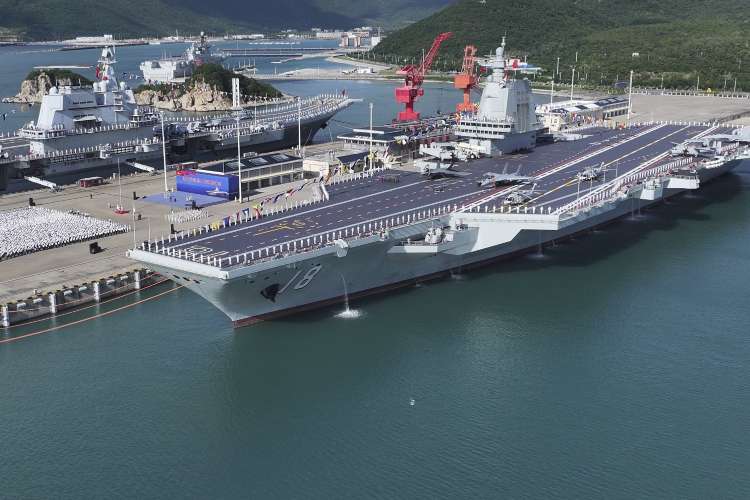
Is China’s Taiwan invasion imminent? Beijing is preparing the option of force, but its immediate campaign is aimed at making Chinese jurisdiction around Taiwan appear routine. A quarantine or blockade is more plausible than an amphibious assault in the near term.
China’s latest move around Taiwan did not involve a missile launch or a record number of fighter sorties. On July 4, two China Coast Guard ships began another “law-enforcement patrol” east of the island, the second such operation in about a month. One vessel came within 54 nautical miles of Hualien. During the June operation, Chinese ships claimed to have inspected 198 passing vessels, challenged three merchant ships and surveyed waters used by undersea cables. Beijing was asserting a right to police the Pacific approaches to Taiwan.
That is a more useful clue to Beijing’s present strategy than the familiar argument over an invasion in 2027. The US intelligence community assessed in March that China’s leaders do not currently plan a Taiwan invasion in 2027 and have set no fixed date for unification. The same assessment said the People’s Liberation Army is developing the plans and capabilities to seize the island if ordered. Both statements can be true. Beijing wants the military option to become credible while it tries to alter conditions around Taiwan without a war.
READ I China’s global governance bid tests India’s diplomacy
China’s Taiwan strategy moves into the Pacific
Chinese ships have operated east of Taiwan before. The claim of law-enforcement authority gives the current patrols a different character. The Taiwan Strait is contested space. The waters east of the island have been treated as open access to the western Pacific and as the route through which outside forces could approach Taiwan during a crisis. China is now testing whether commercial captains, foreign governments and Taiwan’s coast guard will accept instructions issued in Beijing’s name.
A naval deployment advertises military pressure. A coast-guard patrol asserts administration. If a merchant ship answers questions, accepts an inspection or changes course, China can record compliance without firing a shot. If Taiwan intervenes, Beijing can portray Taipei as obstructing routine enforcement. The ambiguity is useful because most governments have plans for a military blockade and fewer have settled how they would respond to a Chinese “quarantine” enforced by cutters, customs notices and selective boarding.
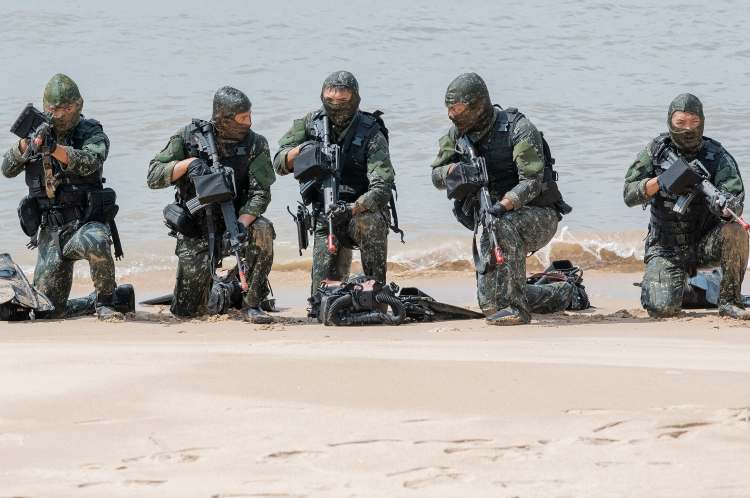

The China Coast Guard has moved closer to the PLA Navy in successive exercises. During Joint Sword-2024B, coast-guard ships operated inside PLA exercise zones around Taiwan. In December 2025, Justice Mission-2025 placed exercise areas near Keelung and Kaohsiung, extended activity east of the island and brought live-fire drills closer to Taiwan’s shores than previous named exercises. The operation disrupted 857 international flights. These were rehearsals for controlling access to ports and air routes, even if Beijing described them as punishment for political acts by Taipei or Washington.
The July patrol adds a legal claim to that operational practice. China already uses coast-guard vessels, survey ships and maritime regulations to press claims in the South China Sea. Applying the same method around Taiwan would allow Beijing to tighten pressure in increments. Each patrol makes the next one less exceptional.
READ I How the US-China reset recasts the QUAD
A Taiwan invasion is not imminent
The year 2027 has acquired a certainty that the evidence does not support. It marks the PLA’s centenary and a military-modernisation target. US assessments have long treated it as a date by which Xi Jinping wants the PLA capable of conducting a successful Taiwan invasion. A capability deadline is not an invasion order. Beijing has never publicly announced such a timetable, and the 2026 US threat assessment says none is now fixed.
An amphibious assault would remain the hardest option available to Xi. It would require the PLA to move forces across roughly 130 kilometres of water, suppress Taiwan’s missiles and air defences, secure ports or beaches, sustain troops under attack and deter US and possibly Japanese intervention. Chinese military writing acknowledges that an invasion or large blockade requires a build-up visible to satellites and other surveillance systems. US intelligence judges that Chinese officials recognise the high risk of failure, particularly if Washington intervenes.
Xi’s purge of the PLA gives him another reason to hesitate. CSIS has counted more than 100 senior officers removed or missing since 2022. By February, five of the six Central Military Commission members chosen by Xi in 2022 had been purged. The campaign reached commanders responsible for the services, theatre commands and the Rocket Force. Analysts differ on the causes, but leadership churn on that scale damages command confidence and combat preparation for the next few years.
The purge does not make the Taiwan problem benign. Xi may be removing officers because he doubts their competence, loyalty or both. The PLA continues to fly across the Taiwan Strait median line, deploy ships around the island and shorten the time between political events and military exercises. China is also working on a “cold start” posture that would allow units to move rapidly before the United States and Taiwan could react. Large amphibious preparations cannot be hidden, but the opening missile, cyber and air operations may arrive with less warning than before.
READ I China-Russia ties: The axis that unsettles the West and Asia
Blockade as the nearer coercive option
A quarantine would suit Beijing’s present methods better than a Taiwan invasion. China could announce customs, safety or environmental rules for selected waters and require ships to identify themselves or submit to inspection. It could begin with Taiwan-bound cargoes, one port or a limited period. The coast guard would lead, while the PLA stayed close enough to deter resistance and foreign intervention. CSIS has mapped such operations as a distinct option below a military-led blockade.
This would force awkward choices on others. A shipping company may comply rather than risk its crew and vessel. Taiwan may escort a ship and risk collision. The United States may challenge the operation and find itself deciding whether a law-enforcement cutter should be treated as a military target. Beijing would try to make every opposing move look escalatory while presenting its own action as domestic regulation.
A blockade would still carry large risks for China. In 26 CSIS war games, Beijing could inflict severe hardship, especially on Taiwan’s energy system, but the operation repeatedly created pressure for wider war. It was neither cheap nor reliably decisive. Taiwan and the United States retained ways to contest it, though at considerable cost.
China also depends on the sea lanes it would disrupt. CSIS estimates that goods worth about $2.45 trillion, more than one-fifth of global maritime trade, passed through the Taiwan Strait in 2022. A full blockade would strike Chinese ports, exporters and insurers as well as Taiwan. That strengthens the case for a partial quarantine designed to test compliance and political resolve before Beijing accepts the economic consequences of open conflict.
Taiwan invasion and Beijing’s political clock
China’s campaign is directed at Taiwan’s political choices as much as its armed forces. In 2025, Wang Huning described Beijing’s task as “shaping the inevitable reunification of the motherland”. Chinese statements for foreign audiences continued to deny an imminent invasion, while domestic commentary used harsher language and argued that unification could happen at any time. The combination is deliberate. Beijing offers economic access to groups it considers friendly, isolates President Lai Ching-te’s government and keeps military punishment available after speeches, elections or arms sales.
Xi’s decision will depend less on an anniversary than on his reading of four conditions: PLA readiness, Taiwan’s politics, the likelihood of US intervention and the cost to China’s economy. Those are the factors identified by the US intelligence community. None points to an immediate assault. Each can change faster than a published timetable.
Taipei has begun to respond to the gap between daily coercion and a full invasion. President Lai has set a goal of combat readiness for joint units by 2027, proposed NT$1.25 trillion in special defence spending over 2026-33 and pledged to take defence expenditure above 3 per cent of GDP in 2026 and to 5 per cent by 2030. Weapons purchases will have limited value if fuel, communications, ports, power systems and civil administration cannot function under prolonged pressure. The coast-guard patrols east of Taiwan are aimed at those seams.
A genuine Taiwan invasion warning would include activity well beyond the current pattern: large-scale requisition of civilian shipping, reserve mobilisation, fuel and medical stockpiling, missile-unit dispersal and sustained closure of air and sea routes. Some of those steps may be disguised by exercises, but the mass required to land and supply an army cannot be concealed altogether. A quarantine could begin with much less preparation.
A Taiwan invasion is therefore not imminent on the available evidence. China is doing something more patient and, for Taiwan, more difficult to answer. It is building the capacity for war while using the coast guard, legal claims and repeated exercises to reduce Taiwan’s control over the space around it. The nearest serious risk is a coercive operation that begins as enforcement, interrupts commerce and leaves other capitals arguing over whether a war has started.