


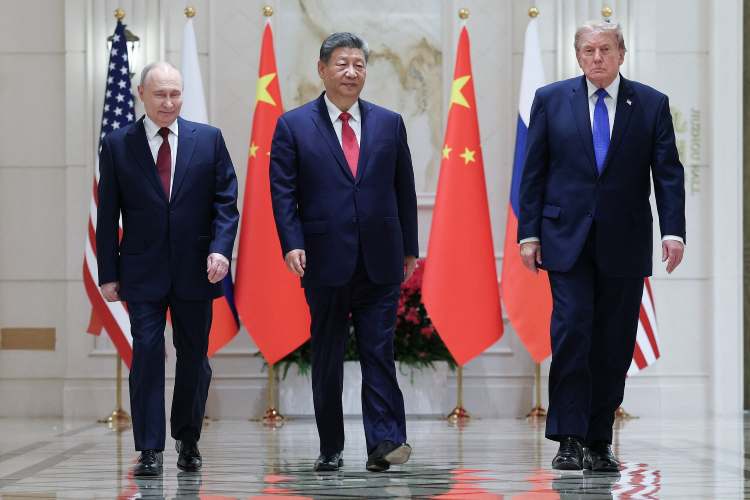
At the Shenzhen APEC summit, the most consequential meeting took place outside the formal proceedings. China’s Xi Jinping hosted Donald Trump and Vladimir Putin on November 19 for talks on nuclear risk and international security. Their joint declaration offered no ceasefire in Ukraine and no timetable for replacing the expired US–Russia nuclear arms treaty. The meeting mattered because of the role the three presidents claimed for themselves.
At a forum that gives 21 economies an equal voice in reaching consensus, three of its most powerful members met separately to discuss questions that affect countries far beyond the Pacific. Washington’s willingness to join Beijing and Moscow in that format was the clearest sign of a changing order.
READ I Trump’s foreign policy: India should read the pattern correctly
China sets the terms of the meeting
Beijing could point to two achievements. It convened the leaders of the world’s three largest nuclear powers on Chinese soil. And it secured a joint declaration in which three permanent members of the UN Security Council pledged to reform the United Nations, with little indication of what they would change or whose voice they would strengthen. For China, the format carried a message of its own. It could convene Washington and Moscow on international security while using APEC to promote its own proposals on digital technology and cross-border data flows.
At the Shenzhen APEC summit, Putin gained a public role in a discussion on international security while Russia’s war in Ukraine continued. Ukraine took no part in the meeting, and the declaration passed over the war. All three governments have reasons to discuss how it might end. A ceasefire that Ukraine has no part in negotiating would give Kyiv little reason to trust the terms or the guarantees behind them. Washington would also need European governments if a settlement involved European sanctions or security commitments. The three leaders could open a negotiation. Much of the work of making it stick would fall to people outside the room.
For Trump, there was a defensible reason to take the meeting. Direct exchanges among nuclear powers can reduce the risk of miscalculation, particularly after New START expired in February. The difficulty lies in moving from a common interest in avoiding catastrophe to limits each side will accept. The Stockholm International Peace Research Institute puts China’s arsenal at about 620 warheads at the start of 2026, against total inventories of more than 5,000 each for Russia and the United States. The figures cover different categories of weapons from those capped by New START, but the gap helps explain why Beijing would resist a single formula for all three countries. The Shenzhen APEC summit left that problem where it found it.
READ I Trump’s UN speech tests America’s claim to global leadership
The leverage behind the diplomacy
The more durable shift at the Shenzhen APEC summit is visible in what Washington and Beijing need from each other. In his separate meeting with Trump, Xi pressed China’s position on Taiwan and called for better communication on trade. Those discussions will continue alongside a contest over access to advanced chips and the materials used in industrial production. The International Energy Agency identifies Chinese dominance in refining the rare earths used in permanent magnets. An economy can have deposits of its own and still depend on Chinese processors for the material that goes into an electric motor. That gives Beijing leverage even with governments that would prefer to buy elsewhere.
A temporary US–China accommodation could help manufacturers by easing restrictions or making deliveries more predictable. It could also make alternative suppliers harder to finance. A processor considering a new plant needs customers willing to commit for years. If the immediate shortage passes, those customers have an incentive to return to the cheapest incumbent. A tariff concession or an export licence can be negotiated much faster than a refinery can be built. Governments that want a second source will have to decide how much they are prepared to pay for it when supplies are plentiful.
READ I Europe’s Russia strategy risks repeating history’s wars
Where Shenzhen APEC summit leaves India
India was not a player at the Shenzhen APEC summit. Its immediate concern is how decisions made there or on its sidelines affect Indian factories and security. A US–China trade understanding could keep Chinese components available to those factories while reducing the incentive for some companies to shift production out of China. The effect would vary by industry. An electronics assembler can benefit from cheaper inputs even as an Indian component maker struggles to win orders. New Delhi needs to know which dependence could stop production during a dispute and where access to low-cost imports helps Indian firms compete.
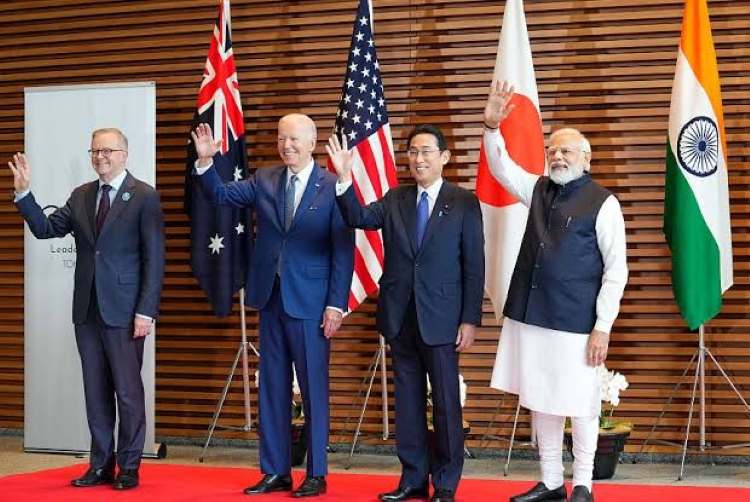

The Quad gives India a way to act on that distinction. In May, Australia, India, Japan and the United States agreed on a critical minerals framework that envisages financing and long-term purchase agreements. New Delhi should use it to bring Indian manufacturers into deals that connect mines to processing plants and commit buyers to taking the output. A purchase contract signed by a group of manufacturers can help secure financing for a plant that none could support alone. The test of the Quad’s value to India is whether arrangements of that kind survive the next easing of tensions between Washington and Beijing.
Russia presents a different problem. Its share of India’s major arms imports fell from 70% in 2011–15 to 40% in 2021–25, according to SIPRI. New purchases can widen India’s choice of suppliers, while equipment already in service will need spares and maintenance for years. New Delhi has reason to keep defence channels with Moscow open. It also has reason to judge future contracts by how much servicing and production India can carry out at home. The terms of a US–Russia rapprochement are beyond India’s control. The terms on which it buys and maintains its equipment are within reach.
India should keep talking to Beijing about the border and build commercial arrangements with Washington, Tokyo and Canberra that can withstand changes in US policy. It can deal with Moscow on the equipment it already fields while giving itself greater choice over the next generation of purchases. Strategic autonomy will be measured in those decisions. When a supplier tightens an export licence or a major power asks for a concession, New Delhi needs alternatives it can use at once. They have to be in place before the call comes.