


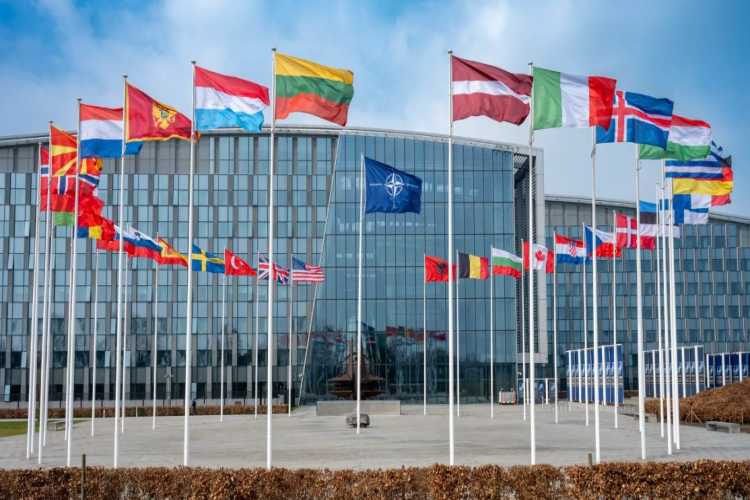
For most of its existence, the North Atlantic Treaty Organisation drew legitimacy from a single proposition: Europe faced an existential external threat that only American power could deter. That proposition no longer holds. What persists instead is an alliance searching for a purpose after the disappearance of the danger that once justified its scale, costs, and discipline. The turbulence surrounding Greenland, Ukraine, and the Atlantic relationship does not signal NATO’s resilience under stress. It reveals an institution whose strategic rationale has thinned, even as its political utility is stretched beyond recognition.
The most telling evidence of NATO’s predicament comes not from Moscow but from Washington. When the alliance’s secretary-general warns European leaders that they “cannot defend themselves” without the United States, he is not describing a military fact so much as reinforcing a dependency that has become politically untenable. Europe’s combined economic output, technological base, and defence-industrial capacity far exceed that of Russia. What it lacks is not capability, but a settled political choice to organise security without American supervision.
READ | Bigger NATO budgets will not preserve western dominance
American guarantees and European dependency
The Greenland episode crystallised this contradiction. A NATO founder and principal guarantor publicly entertained the acquisition—by pressure or force—of territory belonging to a fellow ally. No Russian manoeuvre in the Baltic or Black Sea has done more to corrode confidence in the alliance’s core promise than that moment. Article 5 is credible only if the guarantor is predictable. When the guarantor becomes transactional, credibility collapses.
European unease is therefore not the result of Russian revanchism alone. It stems from the growing recognition that the United States no longer treats Europe as a strategic partner but as an asset to be managed, leveraged, or discounted. The logic is explicit. Washington’s security priorities now sit decisively in the Indo-Pacific. Europe matters insofar as it aligns with American competition against China, absorbs US defence exports, and accommodates American basing and surveillance needs. Beyond that, it is expendable.
This shift is not personal to one president. The rhetoric may be abrasive, but the change has been gradual. Even Presidents more accommodative of alliance language had been reallocating diplomatic, military, and financial capital eastward. Europe’s defence, in that calculus, is a secondary theatre—important, but not determinant. NATO’s insistence that it remains indispensable obscures the reality that it is no longer central to American grand strategy.
Russia is a constraint, not an existential enemy
Russia’s war in Ukraine is often cited as proof that NATO is still relevant. The argument cuts no ice. After years of war, Moscow has failed to secure decisive gains against a non-member state armed with Western assistance. Its conventional forces have been degraded. Its economy is strained. Its military recovery will take years. This does not describe a power poised to roll across Europe. It describes a regional actor whose capacity for sustained large-scale warfare is limited.
READ | Europe must prepare for a NATO without America
This is not to trivialise Russian coercion, cyber operations, or hybrid tactics. It is to recognise proportionality. Europe does not require an American nuclear umbrella and a transatlantic command structure to deter a weakened Russia. It requires coherence, investment, and political will. NATO’s continued framing of Russia as an existential continental threat serves less as analysis than as institutional self-preservation.
NATO as an instrument of American power
What NATO does provide is something else: a framework through which American strategic preferences are embedded into European security decisions. Procurement patterns, force postures, intelligence architectures, and operational doctrines all tilt toward US interoperability and leadership. The result is not collective defence, but managed dependence. European militaries remain fragmented not because integration is impossible, but because NATO has long offered a substitute for it.
This is where Western Europe’s own ambitions complicate the picture. France and Germany speak of strategic autonomy, but remain unwilling to bear its full political and fiscal costs. Smaller states invoke American protection to hedge against both Russia and continental dominance. The alliance becomes a convenient arena in which European power rivalries are suppressed rather than resolved. NATO’s survival thus reflects not a shared threat perception, but an inability within Europe to settle its own hierarchy.
The push for a European army resurfaces at every moment of transatlantic stress. It fades when the immediate crisis passes. This cycle reveals the real obstacle: sovereignty. Defence remains the last redoubt of national authority. NATO allows states to avoid confronting that reality. It offers security without integration, reassurance without responsibility. As long as the United States underwrites the system, the contradiction can persist. When it does not, the structure collapses.
American imperial reflexes accelerate this outcome. The Arctic is illustrative. Washington already enjoys extensive basing rights in Greenland under longstanding agreements. The insistence on ownership reflects a worldview in which control, not cooperation, guarantees security. This is not alliance logic. It is imperial logic. For Europe, the implication is stark: reliance on such a power carries risks that no treaty language can neutralise.
READ | Trump’s ‘golden age’ descends into global chaos
Europe’s strategic autonomy problem
The response from European institutions has been hesitant but revealing. Trade retaliation was considered. Ratification processes were paused. Financial signalling followed. These are not the actions of a confident alliance. They are defensive moves by actors recognising that the rules governing their relationship have shifted. NATO offers no mechanism to address this, because it was never designed to discipline the hegemon.
Russia’s insistence that NATO should have dissolved after the Cold War is self-serving, but not entirely wrong. Alliances are instruments, not virtues. They persist only when the threat environment and internal balance justify them. NATO expanded eastward not because Europe required it, but because the alliance sought relevance and Washington sought influence. The result has been strategic inflation: more members, more commitments, less clarity.
Europe now faces a choice it has deferred for decades. It can continue to inhabit an alliance whose guarantor doubts its value and whose threat narrative no longer convinces. Or it can accept that security, like monetary policy once did, must be internalised to be credible. This does not require hostility toward the United States. It requires independence from American strategic oscillations.
NATO will not disappear overnight. Institutions rarely do. It will hollow out, fragment, and eventually be replaced by arrangements that reflect contemporary power realities rather than Cold War legacies. That is not a catastrophe. It is a correction.
The greater danger lies in mistaking NATO’s decline for vulnerability. Europe’s real threat is not Russian tanks crossing borders, but the continued postponement of political responsibility—enabled by American dominance and masked by alliance ritual. An order built on borrowed power cannot endure. When the lender loses interest, insolvency follows.