


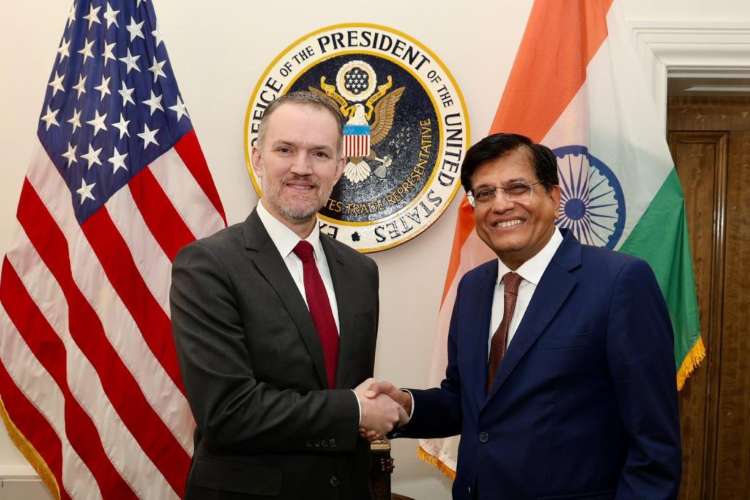
About two weeks ago, the much-anticipated India-US bilateral trade agreement (BTA) seemed close to completion. United States Trade Representative Jamieson Greer led his team to New Delhi, and both governments aligned on claims that 99 percent of the deal was finalised. Immediately after Greer’s visit, however, the Indian government unexpectedly pulled back from the deal.
Clarifying India’s position, Commerce Minister Piyush Goyal, claimed immediately afterwards that the BTA would remain on hold unless the US offered India “some competitive advantage over what is being given to countries like Vietnam, Thailand, the Philippines, Indonesia, Malaysia, China, Bangladesh, Sri Lanka, and other neighbouring countries”.
This about turn was surprising given India’s long-standing enthusiasm to clinch the deal with its second-largest trading partner.
Negotiations began in early 2025 following political endorsement from the leaders of both nations, who launched “Mission 500” to double total bilateral trade to $500 billion by 2030. The BTA was to be the primary catalyst. Initially, both governments agreed that the first tranche of this multi-sector trade deal would be ready by the Fall of 2025.
READ I World order buckles as Iran war tests the West
India-US bilateral trade agreement overly ambitious
This timeline proved overly ambitious for two primary reasons.
The “America First” Mandate of President Donald Trump’s trade policy explicitly stated he would “negotiate agreements on a bilateral or sector-specific basis to obtain export market access for American workers, farmers, ranchers, service providers”. This signaled that the US would prioritise its own stakeholders without guaranteeing reciprocal advantages to partner countries.
And, then there were tariff disputes between India and the US. President Trump repeatedly targeted India for maintaining high tariffs and enjoying a trade surplus with the US. It seemed, therefore, that the India-US bilateral trade agreement was being envisioned as a mechanism for the US to extract market access concessions from India, particularly within its protected agricultural sector.
Although the original deadline was missed, the two nations announced a framework for an “Interim Agreement regarding reciprocal and mutually beneficial trade” in early February. The Indian government enthusiastically hailed this as a “landmark trade victory” that unlocked the “$30-trillion US market for exports across key sectors”. But this optimism did not match the actual terms of the framework.
READ I Trump-FIFA controversy exposes weak sports governance
India had agreed to eliminate or reduce tariffs on all US industrial goods as well as a wide range of agricultural products, but the US secured the right to apply a reciprocal tariff rate of 18 percent on originating Indian goods. By accepting these asymmetric terms, India was, in effect, opening its sensitive sectors even though the US could increase tariffs on Indian exports seven-fold, compared to July 2025 levels.
President Trump announced at the same time that India had committed to halting direct or indirect imports of Russian oil. In exchange, he said, the US had agreed to remove the 25 percent ad valorem duty it had imposed on India in August 2025 over these very oil imports.
For India, halting Russian oil imports represented a major geopolitical shift, considering Russia’s decades-long role as a dependable strategic partner.
READ I Act East policy moves from trade to maritime security
Supreme Court plays the spoilsport
The framework was quickly turned upside down when the US Supreme Court ruled that President Trump did not have the authority to impose “reciprocal tariffs” under the International Emergency Economic Powers Act (IEEPA). This knocked the bottom out of the Trump administration’s trade unilateralism as it was the IEEPA under which high tariffs were levied on 57 countries in April 2025.
The US Supreme Court ruling forced, therefore, both the Indian and US governments back to the drawing board.
India’s initial acceptance of the lopsided February deal remains difficult to parse. Its subsequent refusal to finalise the India-US bilateral trade agreement, however, stems from sudden and new US provocations. Within weeks of the Supreme Court ruling, the Trump Administration initiated two separate investigations under Section 301 of the US Trade Act of 1974, which grants the USTR unilateral tariff authority to investigate and take unilateral tariff actions against other countries it trades with.
In the first investigation, the USTR is examining 60 trade partners for their failure to impose and effectively enforce a prohibition on the importation of goods produced with forced labour. India is among the 54 countries facing the prospects of additional import duties of 10 percent.
The second USTR investigation is for determining structural excess capacity of the countries it trades with. Sixteen of them are being targeted for manufacturing overcapacity across 22 sectors. In India, seven sectors are targeted — including broad categories such as construction goods – meaning that any subsequent duties could broadly depress exports to its largest trading partner, the US.
Unlike the first investigation, the USTR has not as yet specified the duty rates it intends to impose. For decades, governments have been forging bilateral trade agreements to provide a transparent and predictable trading environment to their businesses. The Trump Administration is clearly an exception in this regard; its trade dealings have been anything but predictable.
Given this situation, the Indian government faces some hard choices while continuing to negotiate the India-US bilateral trade agreement. Surely, it would not like to be left in a situation where the US, after extracting all the concessions it is seeking, uses unilateral measures like Section 301 to deny benefits to Indian businesses.
Biswajit Dhar is Honorary Fellow, Institute of Chinese Studies, New Delhi. Earlier, he was Distinguished Professor, Council for Social Development, New Delhi, and a Professor at the Centre for Economic Studies and Planning in Jawaharlal Nehru University, New Delhi. Originally published under Creative Commons by 360info
