


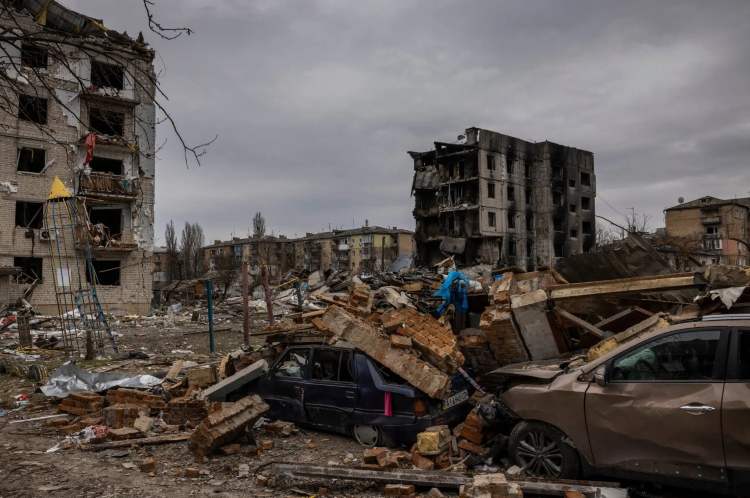
Europe’s Russia strategy: As the war in Ukraine approaches its fourth year, the conflict has settled into a dangerous pattern of endurance rather than resolution. Military frontlines have shifted marginally, but political positions have hardened decisively. What was initially framed as a limited regional war has evolved into a sustained proxy confrontation between Russia and the Western alliance, fought on Ukrainian territory and financed largely by external powers. NATO members have committed well over $200 billion in military, financial, and humanitarian assistance since 2022, according to data compiled by the Kiel Institute. Russia, in turn, has restructured its economy and defence industry for prolonged mobilisation.
This is no longer a war about Ukraine alone. It is a contest over Europe’s post-Cold War security order. By treating Ukraine as a strategic buffer rather than a bridge, Western Europe has allowed a regional conflict to metastasise into a systemic crisis—one with deep historical precedents and potentially catastrophic consequences.
READ I Ukraine peace hinges on Europe scaling back militarisation
NATO expansion and security guarantees
The post-Cold War promise of a cooperative European security order collapsed not because Russia rejected it, but because it was never seriously offered. NATO expanded steadily eastward after 1999, incorporating 14 new members despite repeated Russian objections. This expansion was not matched by binding security guarantees for Moscow or institutional mechanisms to address Russian threat perceptions.

From a legal and institutional standpoint, Europe relied excessively on alliance politics rather than inclusive security frameworks. The Organisation for Security and Co-operation in Europe (OSCE) was marginalised. Arms control agreements such as the Conventional Armed Forces in Europe Treaty were weakened and eventually abandoned. Strategic stability was replaced with deterrence by proximity.
Historical precedent is unambiguous. The punitive containment of Germany after the First World War produced insecurity, revanchism, and ultimately a far deadlier conflict. The Cold War avoided that outcome precisely because it combined deterrence with negotiated security boundaries. Europe has forgotten that lesson. By denying Russia a sense of strategic depth, it has encouraged the very behaviour it claims to resist.
READ I Ukraine war: Why a frozen conflict now looks inevitable
Ukraine as a proxy battlefield, not a solution
Ukraine has become the instrument through which broader geopolitical objectives are pursued. For Washington, the war has achieved several aims without direct military engagement. It has degraded Russian conventional capabilities, increased European defence spending, and reinforced NATO’s relevance. European NATO members are now under pressure to raise military expenditure towards three per cent of GDP, much of it spent on American defence systems.
For Europe, the economic costs have been severe. Energy prices surged after the severing of Russian gas supplies. Germany’s industrial competitiveness weakened sharply. According to Eurostat data, energy-intensive manufacturing output across the EU declined markedly in 2023. Inflationary pressures forced tighter monetary policy, dampening growth.
Russia, by contrast, adapted. World Bank estimates show that the Russian economy returned to growth in 2023 despite sanctions. Trade was rerouted towards Asia. Defence production was scaled up domestically. Sanctions failed to produce regime change or strategic retreat.
Europe is now funding a war it cannot win militarily and cannot exit politically. This is the defining characteristic of a proxy conflict.
READ I A century of mistakes: How Europe’s strategic myopia led to Ukraine crisis
Military imbalance Europe refuses to confront
European strategic rhetoric often exaggerates its readiness for prolonged conflict. The numbers tell a different story. Russia fields the largest standing army in Europe, with over 1.3 million active personnel and a reserve pool exceeding two million. Its defence spending, when adjusted for purchasing power parity, rivals that of all European NATO members combined, excluding the United States.
Europe’s strength lies in economic scale and technological sophistication, not mass mobilisation. Democratic societies face political constraints on conscription, fiscal limits on sustained war spending, and public resistance to long conflicts. Surveys across France, Germany, and the United Kingdom consistently show fragile public support for escalation.
A continental war would impose severe costs on European trade, investment, and social cohesion. Russia has already absorbed a decade of sanctions and militarisation since 2014. Europe has not prepared its societies for comparable strain. Strategic stability cannot be built on illusions of military superiority.
Europe’s Russia strategy must focus on security
The central error in Western European strategy is the assumption that Russian security concerns are illegitimate or purely revisionist. States do not behave rationally when they feel encircled. Security dilemmas escalate precisely because each side interprets defensive moves as offensive threats.
The alternative is not appeasement. It is negotiated security. The Cold War’s most dangerous moments were defused through arms control, crisis communication, and mutual recognition of red lines. The Helsinki Accords, the Anti-Ballistic Missile Treaty, and strategic arms reduction agreements stabilised rivalry without endorsing political systems.
Europe must reclaim strategic autonomy from Washington’s global rivalry framework. Its core interest lies in preventing continental war, not in prosecuting ideological confrontation. A durable settlement will require limits on military deployments, neutral security arrangements for contested spaces, and economic reintegration where possible.
History is unforgiving. Every attempt to forcibly “tame” Russia—from Napoleon to Hitler—ended in large-scale European war. Europe’s security will not be built against Russia, but with clear rules that Russia can live with.
Europe’s Russia strategy needs a strategic reset
Western Europe stands at a strategic crossroads. It can persist with a proxy war that drains its economy, fractures its politics, and entrenches permanent confrontation. Or it can pursue a harder, more mature course: one that recognises Russia as a permanent European power whose security concerns must be addressed, not dismissed.
This does not require endorsing Russia’s actions in Ukraine. It requires acknowledging that exclusion, expansion, and coercion have failed. Stability in Europe has historically depended on negotiated balances, not moral absolutes. The task ahead is institutional, not ideological.
A security architecture that offers predictability to all major actors is the only credible alternative to endless escalation. Europe has paid too high a price in history to repeat this mistake again.