


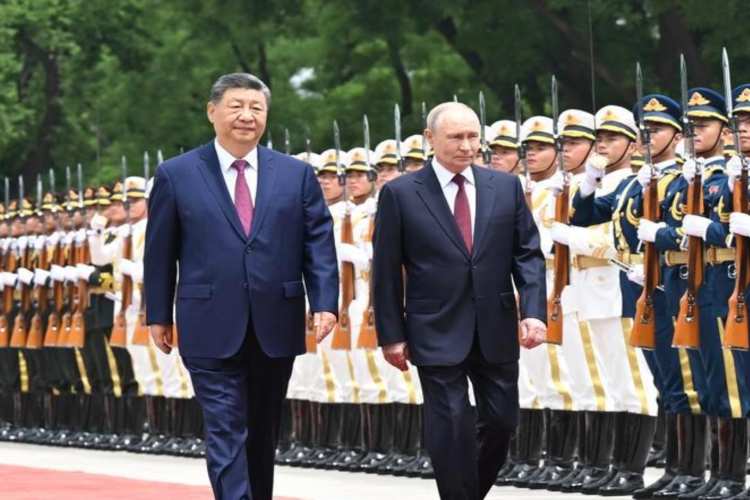
The meeting between Xi Jinping and Vladimir Putin in Beijing was designed to send a message. China and Russia wanted the US, Europe and Asia to see two large powers standing together against what they call American unilateralism. The message was not subtle. Their joint statement criticised US missile defence plans, the lapse of arms control, military strikes on third countries, and the use of sanctions and alliances to contain rival powers.
Yet the deeper meaning of the summit lies not in the rhetoric. It lies in the structure of the relationship. Russia needs China more than China needs Russia. China uses Russia as a strategic asset but avoids the costs of a formal alliance. The United States faces a more coordinated challenge. Europe faces a longer war and a harder China policy. China’s Asian neighbours face a more crowded, more militarised, and less predictable strategic environment. The Beijing summit, however, failed to conclude the Power of Siberia 2 pipeline deal, which is central to understanding the imbalance inside the partnership.
READ | How game theory can help design strategies for climate crisis, diplomacy
China-Russia ties and the US challenge
For Washington, the China-Russia relationship has ended an old comfort. American strategy long assumed that Beijing and Moscow had different interests, different capacities, and enough mutual suspicion to limit cooperation. That assumption is no longer safe.
The two powers do not need a treaty alliance to trouble the United States. They coordinate in the UN Security Council. They echo each other’s language on sovereignty and Western “hegemony”. They conduct joint military exercises and patrols. They help each other absorb sanctions, technology controls and diplomatic isolation. A Council on Foreign Relations report has described the relationship as a quasi-alliance that poses a major threat to vital US interests.
The immediate American problem is strategic distraction. Russia pins the US and Europe down in Ukraine. China raises the cost of US power projection in the Indo-Pacific. Iran and North Korea add pressure in West Asia and Northeast Asia. None of this amounts to a single command structure. It does not have to. The effect is cumulative.
Washington must now plan for simultaneous crises. A Taiwan Strait confrontation could occur while Russia escalates in Europe. A Middle East shock could raise energy prices while Beijing and Moscow blame the US for disorder. The US would still have superior alliances, finance, technology and military reach. But superiority is not the same as freedom of action.
The Beijing summit showed this clearly. Xi and Putin criticised the US “Golden Dome” missile defence plan and the collapse of arms control arrangements. Their purpose was not merely to complain. It was to frame US military modernisation as destabilising while presenting China and Russia as defenders of a more multipolar order.
That argument will not persuade US allies. It may persuade others.
Russia as junior partner, China as banker
The partnership is strong because both sides need it. It is unequal because their needs differ.
Russia needs China for markets, finance, components, diplomatic cover and political legitimacy. Since the invasion of Ukraine in 2022, Western sanctions have cut Moscow off from much of Europe. China has become Russia’s largest trading partner, and bilateral trade reached about $228 billion in 2025, according to Associated Press reporting on the summit.
China needs Russia for energy security, strategic depth, military experience, diplomatic support and pressure on the West. Russia supplies oil, gas and raw materials. It ties down NATO. It supports China on Taiwan. It gives Beijing a permanent Security Council partner willing to oppose Western positions.
But Beijing is not sentimental. The failure to finalise Power of Siberia 2 is the clearest evidence. The pipeline could send up to 50 billion cubic metres of gas a year from Russia to China through Mongolia. Moscow badly wants the project because it has lost much of its European gas market. Beijing can wait. It wants cheap gas, diversified supply and the option not to become dependent on Russia. Reuters reported that only a general understanding has been reached, with pricing and timelines still unresolved.
This is not an alliance of equals. Russia brings disruption. China brings scale.
That asymmetry matters for the West. Sanctions can weaken Russia. They cannot easily break Russia if China continues to provide markets and inputs. But the same asymmetry also matters for Moscow. Putin may speak of sovereign partnership. In practice, Russia’s room for manoeuvre narrows each year the Ukraine war continues.
READ | With Friedrich Merz visit, Indian diplomacy to find its rhythm
Europe’s China problem intensifies
Europe has the most immediate reason to worry. Russia is fighting a war on the continent. China has not supplied Russia with open military backing on the scale of an ally, but it has helped sustain the Russian economy and defence-industrial ecosystem. European governments increasingly see Beijing not as a neutral actor but as an enabling power.
This complicates Europe’s old China policy. For years, the European Union tried to separate trade from security. Germany sold machinery and cars. China bought European goods and technology. Brussels worried about subsidies, market access and human rights, but the relationship remained anchored in commerce.
The Ukraine war has changed the calculation. If China helps Russia endure sanctions and continue the war, Europe cannot treat China only as a market. The issue is no longer limited to trade deficits or electric vehicles. It is about the security order in Europe.
That does not mean Europe will fully align with Washington on every China policy. European industry remains exposed to China. The EU also fears a second “China shock” as dependence on Chinese industrial inputs grows and European manufacturers face subsidised competition. Recent reporting has warned of rising European concern over cheap Chinese imports and supply-chain dependence.
Europe therefore faces a double bind. It wants American protection against Russia. It wants autonomy from American political volatility. It wants Chinese markets. It distrusts Chinese support for Moscow. These cannot all be reconciled.
The likely result is a tougher but uneven European China policy. More screening of investment. More export controls. More scrutiny of dual-use goods. More industrial policy. Less faith in engagement for its own sake.
Asian neighbours read the signal
China’s Asian neighbours will read the Xi-Putin summit differently from Washington or Brussels. They will not see it only through Ukraine. They will see it through borders, energy routes, arms transfers, sea lanes, and China’s growing appetite for regional dominance.
Japan will see a tighter China-Russia axis as a direct security concern. Chinese and Russian military activity around Japan has already sharpened Tokyo’s threat perception. If Russia remains aligned with China in Northeast Asia, Japan must plan for pressure from the north and south.
South Korea has a different anxiety. The China-Russia relationship intersects with North Korea. Moscow’s closer ties with Pyongyang, Beijing’s reluctance to isolate North Korea, and the weakening of sanctions enforcement all increase uncertainty on the Korean peninsula. A looser sanctions regime gives North Korea more room to trade, test and threaten.
Southeast Asia will be more cautious. Vietnam values Russia as a defence partner but fears Chinese pressure in the South China Sea. Indonesia, Malaysia and Thailand will avoid choosing sides where possible. The Philippines, already closer to Washington because of China’s maritime conduct, will see the partnership as another reason to deepen US and Japanese security links.
Central Asia faces the most delicate problem. Russia has historic security influence. China has become the larger economic power. The war in Ukraine weakened Russia’s aura but did not remove Russian leverage. China’s Belt and Road investments and energy interests give Beijing growing weight. The Central Asian republics will bargain with both powers while trying not to be absorbed by either.
India’s position is especially complex. Russia remains a long-standing defence and energy partner. China remains India’s principal strategic rival. A Russia increasingly dependent on China is bad news for New Delhi. It reduces Moscow’s ability to act as a balancing partner. It also complicates India’s effort to maintain strategic autonomy while deepening ties with the United States, Japan, Australia and Europe.
The West should not overstate the axis
There is a temptation in the West to describe China and Russia as a new monolith. That would be a mistake.
Their partnership has limits. Russia is anxious about becoming China’s raw-material appendage. China does not want to inherit Russia’s liabilities. Beijing wants access to Europe, technology, capital and global markets. It does not want a total rupture with the West. The stalled pipeline shows that China will bargain hard even with its closest strategic partner.
There is also mistrust. Russia remembers past Chinese claims and influence in the Russian Far East. China remembers Russian power politics. Both know that today’s friendship rests less on affection than on shared opposition to US primacy.
This is why the partnership should be treated neither as a temporary convenience nor as an unbreakable alliance. It is more durable than a transaction. It is less binding than a treaty. It is best understood as a strategic alignment of two revisionist powers with unequal capabilities and overlapping resentments.
That makes it harder to manage.
The rest of the world gains bargaining space
Many countries in the Global South will not view China-Russia ties with Western alarm. They will see opportunity. More great-power competition can mean cheaper finance, discounted oil, defence options, diplomatic cover, and room to resist Western pressure.
This does not mean they trust Beijing or Moscow. It means they will use them. Gulf states will trade with China, coordinate with Russia on energy, and keep security ties with Washington. African states will welcome infrastructure, arms and diplomatic attention. Latin American governments will use Chinese finance and Russian political support when it suits them.
The West often misreads this as ideological drift. In many cases, it is bargaining. Countries that resent Western lectures may still prefer Western markets, universities, technology and legal systems. They may also dislike Chinese debt, Russian arms dependence and coercive diplomacy. Their position is not pro-Russian or pro-Chinese. It is transactional.
The danger for the West is not that most countries will join an anti-Western bloc. They will not. The danger is that they will stop believing the West can set the rules.
READ | Venezuela and the return of gunboat diplomacy
What the US and allies should do
The first response should be discipline. The US and Europe should not drive Russia and China closer through rhetorical excess while doing too little to raise the cost of their coordination. Nor should they pretend that a grand bargain with Moscow will detach Russia from Beijing. That possibility has narrowed sharply since 2022.
The second response should be allied capacity. NATO must sustain Ukraine and rebuild European defence production. The US must strengthen deterrence in the Indo-Pacific without making Asian partners feel they are being enlisted into an automatic anti-China bloc. Japan, South Korea, Australia, the Philippines and India do not have identical threat perceptions. Strategy must allow for that.
The third response should be economic statecraft. Sanctions on Russia will remain leaky if dual-use goods, finance and logistics continue to flow through permissive channels. Export controls must focus on military-relevant technologies, not symbolic decoupling. Europe must reduce critical dependencies on China without damaging its own industrial base.
The fourth response should be diplomatic humility. Many countries will not support Western positions merely because Russia invaded Ukraine or China threatens Taiwan. They will ask what the West offers in finance, trade, climate resilience, food security and technology. A sermon is not a strategy.
The Xi-Putin embrace is not the birth of a new world order. It is evidence that the old one is fraying. China is testing how far it can rise without open war. Russia is testing how much disruption it can survive. The United States is discovering that power is harder to use when rivals coordinate. Europe is learning that commerce cannot be insulated from security. Asia already knew this.
The rest of the world will hedge. That may be the most important fact of all.