


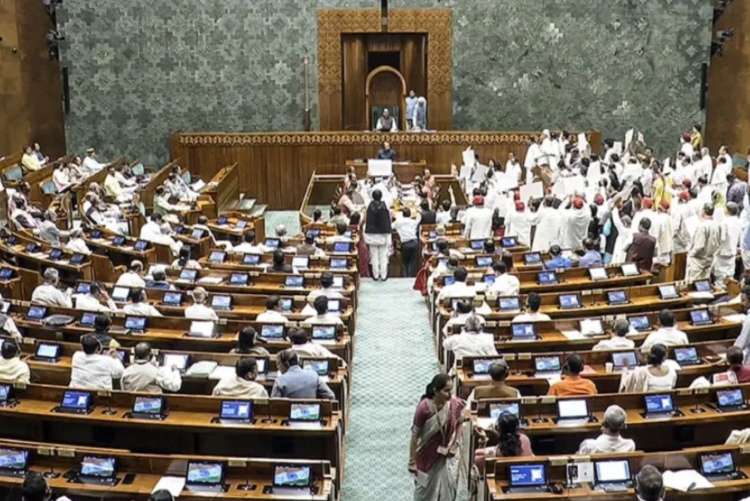
The Monsoon Session has shown how Parliament can remain in session without performing its central function. The session ended on Thursday following continued protests by the opposition parties over police action during the recent student protest. Several important bills were passed without debate. With the session due to end on August 13, legislation concerning delimitation, women’s reservation and foreign contributions are likely to be put on hold.
The government has the numbers to pass ordinary legislation. The Opposition has enough members to interrupt proceedings. Neither fact answers the constitutional question. Parliament exists to subject executive decisions to public examination. When debate is prevented and Bills are passed through the noise, the House becomes another site of political combat.
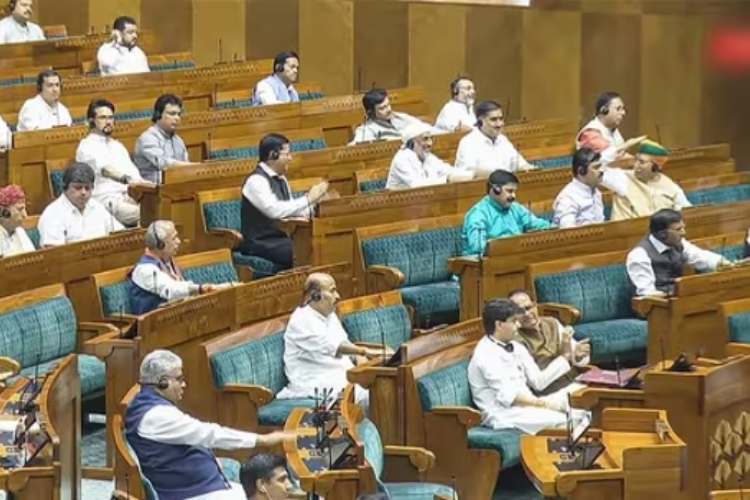

That failure carries consequences beyond Parliament. India’s political and social divisions are deepening at a time when the institutions meant to mediate them are losing authority. Religious identity has entered the daily vocabulary of political discourse. Caste determines candidate selection, electoral alliances and access to state benefits. Disputes over language, taxation, migration and representation are sharpening regional sentiment. Political opponents are frequently treated as enemies of the nation.
The idea of India fashioned during the freedom movement offered an answer to these divisions. The Republic would belong equally to citizens of every religion, caste, language and region. A majority would govern for a fixed term. It would not acquire ownership of the country. That compact now needs institutions capable of enforcing it.
READ I When youth protest tested the limits of centralised governance
The Monsoon Session and Parliament’s retreat
The Opposition’s demand for a debate is legitimate. Paper leaks and arbitrary cancellations are questions of administrative responsibility. So is the freedom to protest. They belong in Parliament.
Disrupting Question Hour and preventing ministers from answering weakens that demand. A minister forced to place facts on the record can be held to them. A minister prevented from speaking can claim that the Opposition feared an answer. Slogans produce television footage and leave the government’s account untested.
The government’s response has been worse. It has treated disruption as sufficient reason to pass legislation without scrutiny. A Bill does not become less consequential because the Opposition is shouting. The obligation to explain each provision rests with the minister introducing it. A government that uses disorder to avoid debate acquires an interest in disorder.
The pattern predates this session. During the 2026 Budget Session, Lok Sabha approved 77% of the Union government’s expenditure demands without discussion. Only one Bill passed during that session had undergone examination by a parliamentary committee. On 12 days, Question Hour lasted less than 15 minutes.
Lok Sabha has had no Deputy Speaker since June 2019. Article 93 requires the House to choose a Speaker and a Deputy Speaker as soon as possible. Seven years of inaction cannot be explained as a scheduling difficulty. The vacancy denies the Opposition its traditional place in the management of the House and leaves a constitutional office unfilled because the ruling party finds that convenient.
The freedom movement placed Parliament at the centre of the Republic for a reason. India contained interests that could not be reconciled by executive order. Parliament was intended to convert social conflict into argument, amendment and compromise. Its decline sends those conflicts back to the street.
READ I Digital protest is reshaping democratic accountability beyond elections
Delimitation will test Indian federalism
The unfinished business of the Monsoon Session includes an issue capable of altering the federal compact. The government has been considering a revised proposal on delimitation after the Constitution (131st Amendment) Bill failed to secure the required majority in the Budget Session. The earlier proposal sought to expand Lok Sabha and enable delimitation on the basis of the 2011 Census. The related Bills then became infructuous.
Delimitation cannot be handled as another item on a crowded legislative list. It will determine how political power is distributed among states for decades. Southern states that reduced fertility fear losing parliamentary influence to states with faster population growth. The latter can fairly argue that representation should reflect the number of citizens.
The dispute has no arithmetical solution that all states will regard as fair. Rewarding demographic performance cannot mean freezing political representation forever. Increasing representation for populous states cannot leave other states believing that successful implementation of national policy has reduced their voice in the Union.
A Constitution amendment introduced late in a session and pushed to a vote would deepen the grievance. The government should publish the alternatives, their state-wise consequences and the principles used to choose among them. A parliamentary committee should hear state governments. The Inter-State Council should discuss the proposal before Parliament takes it up.
The method will determine whether the eventual settlement is accepted. A numerical victory in Parliament will not settle a dispute over the distribution of parliamentary power.
READ I Student protest restores ministerial accountability
Majority rule has constitutional limits
India’s freedom movement did not produce social agreement. It produced a political compact among people who disagreed on religion, caste, language, property and the character of the state.
The Karachi Resolution of 1931 promised civil liberties, religious freedom and equality before the law. The Objectives Resolution of 1946 recognised justice and equality as obligations of the state. B R Ambedkar warned that political equality would coexist with severe social and economic inequality. He placed fraternity alongside liberty and equality because the Constitution could not hold a caste society together through coercion.
The compact survived Partition because citizenship was not tied to the religion of the majority. It survived linguistic conflict because the Union eventually accepted states organised around language. It survived changes of government because an electoral defeat did not strip the defeated party or its voters of their rights.
Majoritarian politics alters that arrangement. It identifies the electoral majority with the social majority and the social majority with the nation. Criticism of the government then becomes disloyalty. Minority protection becomes appeasement. A state’s objection to Union policy becomes obstruction of national progress.
A government is entitled to implement its programme. It is also bound by rights that do not depend on its electoral mandate. Freedom of religion, equality before the law, federal distribution of power and judicial review are restrictions upon every majority. Without those restrictions, an election decides more than who governs. It decides whose account of India receives the force of the state.
Institutions cannot borrow the govt’s authority
The Election Commission, governors, central investigative agencies and the police possess powers that affect political outcomes. Their authority depends upon a distinction between the state and the government holding office. That distinction has become harder to see.
The Election Commission must answer concerns over electoral rolls, campaign violations and polling procedures with verifiable information. A constitutional body cannot expect trust because it has declared itself independent. Its orders must show that comparable cases received comparable treatment.
Governors have delayed action on Bills passed by elected legislatures, forcing state governments to approach the Supreme Court. Such delay changes the constitutional balance without amending the Constitution. A governor who withholds a decision indefinitely exercises a veto unavailable under the text.
Investigative agencies have also invited doubt. Proceedings against Opposition leaders often gather pace near elections. Some cases lose urgency after the accused changes political allegiance. The government may offer an explanation for each case. The recurring pattern has damaged the agencies’ credibility.
The police present the most direct test. The Supreme Court’s directions in Prakash Singh were issued in 2006. State security commissions remain ineffective in several states, fixed tenures are routinely avoided and police complaints authorities lack independence. Governments of different parties have resisted reform because they value control over the police more than they value an impartial police force.
That preference has a social cost. During communal violence, an arrest is judged by the identity of the accused and the political affiliation of the state government. A police force suspected of partisan conduct cannot restore confidence through a curfew. It may suppress violence while leaving the grievance intact.
India imposed 65 internet shutdowns across 12 states and Union territories in 2025, according to Access Now. The number was the lowest since 2017, yet it showed how readily administrations disable communication during protests, communal tension and religious events. A shutdown burdens students, traders, hospitals and payment systems across an entire district because the state lacks the capacity or patience to act against identified offenders.
Courts cannot carry the whole Constitution
As Parliament retreats from scrutiny and executive institutions lose credibility, political disputes arrive at the courts. Governors’ delays, electoral rules, arrests, internet restrictions, citizenship questions and disputes between the Union and states are increasingly presented as constitutional litigation.
Judicial review is indispensable. It cannot become the ordinary method of government. Courts intervene after a political or administrative process has failed. They act on the dispute placed before them, often after months or years. They cannot conduct parliamentary debate, administer the police or negotiate a federal settlement.
The justice system also lacks the capacity to absorb an unlimited transfer of political responsibility. More than five crore cases are pending across Indian courts. Judicial posts remain vacant. The lower courts, where most citizens encounter the law, work under severe pressure.
Delay is not socially neutral. A company can fund prolonged litigation. An undertrial prisoner, dismissed worker or woman seeking maintenance may lose before judgment because the proceedings consume years. A constitutional promise that arrives after the injury has become irreversible offers little protection.
Governments speak often about judicial reform and fill vacancies slowly. High courts and state governments blame one another for delays in recruitment. The result favours the stronger litigant and weakens faith in equal treatment.
Federalism is a condition of national unity
The Union’s relations with the states will face harder disputes over tax devolution, centrally sponsored schemes, language and migration. The division is unlikely to follow a simple north-south line. States differ in income, fertility, age profile and dependence on Union transfers. Their interests will change as these indicators change.
The Finance Commission must therefore explain how its formula distributes gains and losses. Centrally sponsored schemes should not be designed so rigidly that elected state governments become implementing agencies for programmes conceived in New Delhi. Governors cannot serve as instruments for managing opposition-ruled states. The Inter-State Council should meet before disagreements reach the Supreme Court.
Language requires similar restraint. Hindi has the largest number of speakers. That fact does not confer upon it an unrestricted claim over education, recruitment or administration in non-Hindi-speaking states. The anti-Hindi agitations of the 1960s established that linguistic accommodation strengthens the Union. Attempts to secure uniformity through administrative pressure will revive a conflict that political judgment once contained.
Federalism allowed India to accommodate competing accounts of public policy and identity. Tamil Nadu could pursue its social-policy settlement, Kerala another and states in the Northeast arrangements shaped by their histories. Centralisation turns each difference into a contest for control over national policy.
The freedom movement’s idea of India
The freedom movement included socialists, conservatives, religious reformers, secularists, defenders of caste and campaigners against it. Its leaders disagreed over separate electorates, language, property, village government and the powers of the Union. The Constitution did not erase those disagreements. It established the terms on which they could continue without destroying the Republic.
Those terms were exacting. An adult’s vote would not depend on education or wealth. The state would have no official religion. Untouchability would be abolished. Linguistic communities would receive political recognition. Courts could restrain elected governments. A citizen’s place in India would not be conditional on support for the ruling party.
The current Monsoon Session offers a modest but revealing test of that inheritance. Can Parliament debate the failures that have angered young job seekers? Can the government resist passing Bills without examination? Can the Opposition use the procedures of the House instead of disabling them? Can a proposal as consequential as delimitation be subjected to consultation rather than managed as a contest of numbers?
The answers will not be found in invocations of constitutional values. They will be found in the time allotted to debate, the Bills sent to committees, the questions ministers answer and the respect shown to views that cannot prevail in a vote.
India is unlikely to split into hostile territorial camps. Its divisions overlap too extensively. A more plausible loss would occur within the existing borders. Citizens would continue to vote while becoming less certain that the state belongs equally to them.
An Indian should be able to lose an election, criticise the government, speak a minority language or profess a minority faith and remain secure in his claim upon the Republic. The freedom movement made that promise. Parliament was created to keep it.