


Middle East diplomacy appeared to falter on Monday, September 14, after a planned meeting between Iran and other Gulf states was postponed, while attacks around two of the region’s most important oil transit routes deepened concern about global energy supplies.The escalation had built over the weekend. Houthi strikes on Saudi Arabia, the world’s biggest oil exporter, forced the closure of its 1,200-km east-west pipeline, a key route used to move crude across the kingdom while bypassing the Strait of Hormuz. The shutdown helped push oil prices more than 3 percent higher.
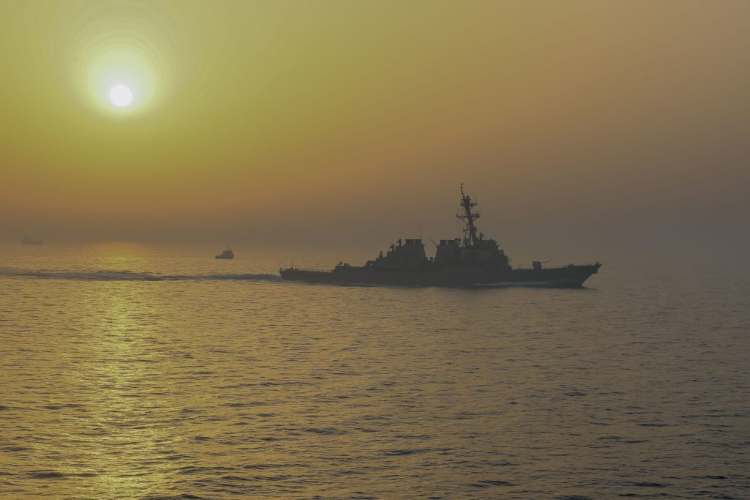
At the same time, Hormuz itself remained exposed. The British maritime security agency UKMTO said on Sunday, September 13, that a vessel had been struck by a projectile while moving through the strait, causing a fire and forcing the crew to evacuate. Together, the pipeline closure and the incident in Hormuz highlighted the vulnerability of both the main waterway and the alternative route around it.
The security escalation coincided with renewed economic pressure from Washington. On August 7, the US Treasury’s Office of Foreign Assets Control sanctioned a network operating between the Gulf and Asia, accusing it of helping Iran’s shadow banking system move hundreds of millions of dollars illicitly. The designations targeted two Dubai exchange houses, financial intermediaries, front companies linked to an Iranian bank and shell companies based in Hong Kong and Singapore.
READ I Trump’s UN speech tests America’s claim to global leadership
Just over two weeks later, on August 24, the Treasury secretary announced “Operation Economic Outcast”, marking a return to financial pressure after months dominated by military escalation. Unlike the broad sanctions imposed after the US withdrawal from the nuclear deal in 2018, the new campaign targets entities accused of helping Iran exploit loopholes and keep parts of its economy functioning despite restrictions. Seen together, the August 7 designations and the August 24 campaign point to a shift from broad punitive measures to tighter control of the financial channels that allow sanctioned trade to continue. The campaign is therefore less a conventional escalation than an attempt to close the gaps in the sanctions architecture.
While public attention has focused on Hormuz as the obvious chokepoint, financial sanctions have remained at the margins of the debate. Yet the financial network may be the more decisive pressure point. Hormuz has become the symbol of weaponised interdependence, but the less visible chokepoint – the system that allows Iran to move money and sustain trade – may be the one that matters most.
From frozen assets to network control
The history of financial sanctions against Iran began on November 14, 1979, ten days after the seizure of the US embassy in Tehran and on the same day the Iranian government announced its intention to withdraw its holdings from American institutions. Under Executive Order 12170, President Jimmy Carter ordered the freezing of Iranian government and central bank property subject to US jurisdiction, extending the measure to balances held at all foreign branches and subsidiaries of American banks, including those in Europe. The crisis ended almost a year and a half later, on January 20, 1981, with the Algiers Accords, whose negotiation also covered the fate of the frozen Iranian funds.
The 1979 measure, though a relatively conventional form of sanction based on controlling assets subject to US jurisdiction, made clear the potential scope of financial-network leverage. Inevitably, within a few decades, the target shifted from dollar flows to the channels through which they are transferred. At the centre of this shift was SWIFT, the cooperative established in Belgium in 1973 by 239 banks from fifteen countries to standardise international interbank messaging. SWIFT is not a bank and does not execute payments, but transmits the instructions through which intermediaries carry them out. Its growing centrality has turned it into an essential piece of international payments infrastructure, from which excluding users can create significant leverage.
The concept of weaponised interdependence, developed by Henry Farrell and Abraham Newman in 2019, helps explain this mechanism, showing how global economic networks tend to concentrate around a small number of nodes and how states with effective jurisdictional control over such nodes can convert that centrality into two distinct capabilities: observing the flows that pass through them, known as the panopticon effect, and selectively cutting them off, known as the chokepoint effect.
In SWIFT’s case, these capabilities developed through different channels. The cooperative is subject to Belgian law and the supervision of the National Bank of Belgium. However, one of its operating centres is located in the United States.
After September 11, 2001, the Treasury, through the Terrorist Finance Tracking Program, gained access to messages stored at SWIFT’s American site, reflecting the panopticon effect. After the programme became public in 2006, European objections over data protection led to it being brought within a negotiated framework. Since 2010, the transfer of financial messaging data from the European Union to the United States has been governed by an agreement that limits US requests.
The capacity for exclusion, the chokepoint effect, by contrast, emerged in 2012, when a decision of the Council of the European Union banned providers of specialised financial messaging services from operating on behalf of Iranian institutions subject to asset freezes, including SWIFT. That same day, SWIFT announced it had been instructed to suspend services, which were cut off on March 17 that year. The measure was thus formally European but adopted under strong American pressure. In practice, without directly imposing the disconnection, Washington used its position within the network to steer the action of another jurisdiction.
The most significant case, however, came after the US withdrawal from the JCPOA, the Joint Comprehensive Plan of Action, in May 2018, when European and American policy diverged openly. In August, the updated Blocking Regulation entered into force, under which the European Union barred its own operators from complying with extraterritorial US sanctions, while then Treasury Secretary Steven Mnuchin publicly warned that SWIFT itself could be sanctioned should it continue serving designated institutions.
On November 5, the day the second tranche of US sanctions was reactivated, SWIFT nonetheless suspended access for some Iranian banks, citing the stability of the global financial system and making no mention of the US sanctions, a decision the European Commission called regrettable. The exclusion was thus no longer aligned with the European position, as it had been in 2012, but ran against it. Europe’s attempt to build an independent channel with INSTEX, established in 2019 and wound up in 2023 after a single transaction, only exposed the gap between intention and the capacity to create a workable alternative to SWIFT.
That the panopticon and chokepoint effects remain active today is shown by the designations of August 7, 2026. To reconstruct the network described at the outset, the Treasury identified not only the companies involved but also the individuals running their operations, a sign of sustained intelligence-gathering over time. On this basis, it then warned that foreign financial institutions risk losing access to US correspondent accounts, indirectly fuelling the phenomenon of overcompliance as well.
Iran and Hormuz chokepoint
In recent months, there has been a proliferation of articles describing Hormuz as a chokepoint to which, by transitive property, the theory of weaponised interdependence could be applied — a reading that, besides being imprecise, risks diluting the theory’s proper meaning. There is no doubt that the Strait is one of the most important geoeconomic chokepoints globally, but it belongs to a different category from the one through which weaponised interdependence manifests itself.
The nodes in the networks described by Farrell and Newman are the result of concentration produced by economies of scale — that is, successive economic choices that have made alternatives costly — whereas Iranian control over the Strait derives from geography and from the military capacity to interdict passage through it.
What the two positions yield to those who hold them is also quite different. Control of the Strait produces above all a transit rent, which Tehran has sought to institutionalise through the Persian Gulf Strait Authority (PGSA), while centrality in a payments network yields knowledge of the flows passing through it and the ability to condition the intermediaries taking part in it. This also explains how the former position can be neutralised by the latter, as happened when the US declared transit tolls unauthorised and sanctioned the PGSA.
Forty-seven years of exclusion have not produced an Iranian response capable of substituting for the main international payments infrastructure. Channels developed with Russia remain marginal, while oil exports pass largely through opaque circuits, some of which were hit precisely by the designations of August 7, 2026.
The price of reopening Hormuz
On August 8, Iran set out six conditions for reopening the Strait, three of which concern the financial dimension: compensation for war damage, the lifting of sanctions and the release of frozen assets. As of today, the June 17 memorandum has expired and the negotiation remains stalled on everything relating to the economic and military conditions attached to any future reopening.
The direction of American pressure seems set to continue. On August 13, the Treasury secretary signalled new economic measures of unprecedented scope, increasing the risk that prolonged use of this tool could push affected actors to seek alternatives, as shown by the growth, albeit still very limited, of alternative financial circuits.
The point, then, was never only about control of Hormuz. Recent months have made clearer than ever that the financial network through which Iran conducts its trade is the chokepoint best suited to serving as a coercive lever. It is this network, less visible and less covered by the media, that forms an essential part of Washington’s strategy against Iran and that will decisively determine the price of reopening Hormuz.
Giulia Olini is PhD Candidate in Institutions & Politics (International Relations concentration) at Università Cattolica del Sacro Cuore, Milan. Her PhD project asks whether the logic of weaponized interdependence operates within the transatlantic alliance itself, tracing how dollar-based financial infrastructures have been mobilised since 2001. Originally published under Creative Commons by 360info
