


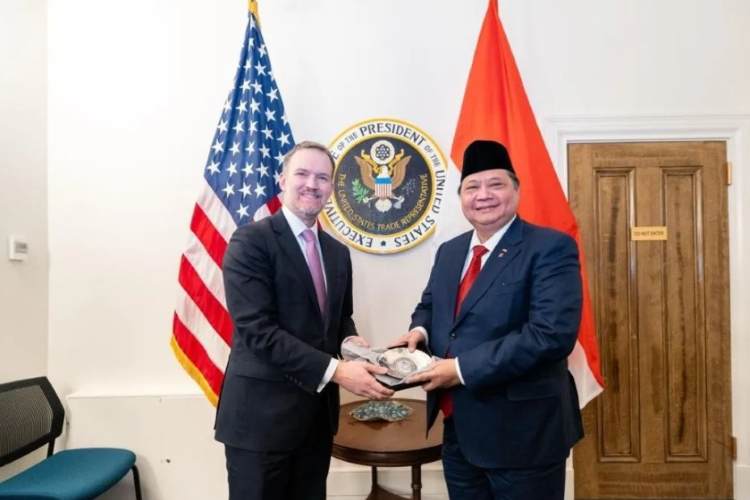
The Indonesia-US Agreement on Reciprocal Trade (ART) has triggered wide debate among legal scholars, economists and policymakers. In international treaty law, two principles exist in constant tension: pacta sunt servanda, meaning agreements must be honoured, and rebus sic stantibus, meaning a treaty binds only as long as the conditions that created it remain the same. ART, signed in February 2026, is a case where these two principles collide.
The word “reciprocal” in the Indonesia-US Agreement’s title is a diplomatic label that hides more than it explains. The phrase “Indonesia shall” appears more than 200 times across 45 pages, while “United States shall” appears only nine times. This 22‑to‑1 ratio is not a mistake. It reflects a built-in imbalance of power written into binding obligations.

Indonesia agreed to remove tariffs on 99 percent of American goods, buy energy, agricultural products, and commercial aircraft worth $ 33–38 billion, and give up control over its digital regulations, including removing taxes on American digital service companies and duties on electronic transmissions.
The United States offered a 19 percent tariff rate on Indonesian exports. That rate turned out to be higher than the standard 10–15 percent applied to all other countries after the US Supreme Court struck down the IEEPA tariff system the next morning. Indonesia negotiated for months to secure a worse result than it would have received by doing nothing.
READ I Trump tariffs and the new grammar of global trade
Three legal problems that require answers
The Indonesia-US Agreement contains legal weaknesses across three areas. Each one alone is enough to justify renegotiation, and together they form a strong argument that is hard to dismiss.
- The agreement’s basic foundation is flawed
The ART was created under the pressure of a threatened 32 percent tariff imposed through the International Emergency Economic Powers Act (IEEPA), which the US Supreme Court declared unconstitutional on February 20, 2026 in a 6–3 ruling. Article 62 of the 1969 Vienna Convention on the Law of Treaties states that when a major change in circumstances forms the essential basis of consent, was not expected when the treaty was made, and drastically changes the remaining obligations, a country may end or renegotiate the treaty.
The 32 percent IEEPA tariff was not background context. It was the key condition that shaped the entire agreement. To claim that the agreement remains fully valid after the main source of pressure has been struck down is a legal argument that cannot withstand serious examination.
- The agreement violates proportionality
In trade law, proportionality is not a moral idea but a legal standard used to judge whether a rule goes further than necessary. WTO Panels use a “necessity test” under Article XIV of the General Agreement on Trade in Services to check whether a regulation is more restrictive than needed to achieve a legitimate goal.
A total ban on digital taxation, without any special allowance for a developing country, goes beyond what is reasonable. It gives up long‑term policy tools in exchange for market access benefits that are unevenly distributed.
Digital trade agreements that remove regulatory space from developing countries create permanent restrictions that block future law‑making across entire sectors. Indonesia accepted exactly these terms.
- The agreement forces massive changes to Indonesia’s legal system
An economist calculated that full ART compliance requires Indonesia to create 26 new regulations and amend 91 existing ones, for a total of 117 legal instruments. This includes:
- 6 new laws and 26 amendments to existing laws
- 4 new government regulations and 8 amendments
- 11 new presidential decrees and 6 amendments
- 5 new ministerial regulations and 45 amendments
- 3 amendments to Bank Indonesia rules and 3 amendments to Financial Services Authority rules
This is not a small administrative adjustment. It is a complete restructuring of Indonesia’s legal system to fit the obligations of a single bilateral agreement—an agreement whose legal basis has already been struck down in the country that demanded it.
At the constitutional level, experts have identified at least eight ART provisions that conflict with the 1945 Constitution, affecting at least seven constitutional articles, including Article 33, which the Constitutional Court has repeatedly interpreted as requiring democratic oversight for all natural resource contracts.
The extension of Freeport McMoRan’s mining permits to 2061 and ExxonMobil’s contracts to 2055—placed quietly inside a trade agreement clause instead of being processed through the required constitutional procedures—is both a commercial deal and a bypass of constitutional rules.
READ I New GDP series lifts growth outlook, but oil and trade risks persist
The Indonesia-US Agreement
The government has not explained why no formal renegotiation request has been submitted. The Vienna Convention provides a clear process: a formal notification that opens the door to renegotiation without creating conflict. The geopolitical argument—that maintaining US favour is more valuable than the concessions made—deserves consideration. But it does not justify keeping an agreement that is flawed in its legal basis, unbalanced in its obligations, constitutionally questionable, and damaging to Indonesia’s legislative system.
Three steps are urgently needed:
- The House of Representatives should pause (not reject) the ratification process under International Agreements Law until full public discussion of the eleven related business agreements is completed.
- The government should submit an Article 65 notification as a clear legal position, not a hostile act.
- Indonesia should build a joint ASEAN negotiating stance with Vietnam, Malaysia, and Cambodia, who face similar pressure, creating a stronger collective response than isolated bilateral negotiations.
Behavioural economics calls it the “sunk cost fallacy” when people persist with a bad decision simply because they have already invested in it. The ART is a clear example of what happens when diplomatic convenience replaces legal judgement, and when short‑term geopolitical concerns outweigh long‑term economic independence.
Indonesia signed an agreement it did not need to sign, accepted terms it did not need to accept, and received a tariff rate it would have obtained without giving up anything. International law provides a legitimate and technically sound path for correction. The real question is no longer whether that path exists, but whether the political will to take it does.
Muhammad Ikhsan Alia is a lecturer in Business Law and International Treaty Law, Faculty of Law and a Senior Researcher at the Centre for Constitutional Studies (PUSaKO) in Universitas Andalas. Indonesia Delegate, International Visitor Leadership Program (IVLP), US Department of State, 2025. Originally published under Creative Commons.