


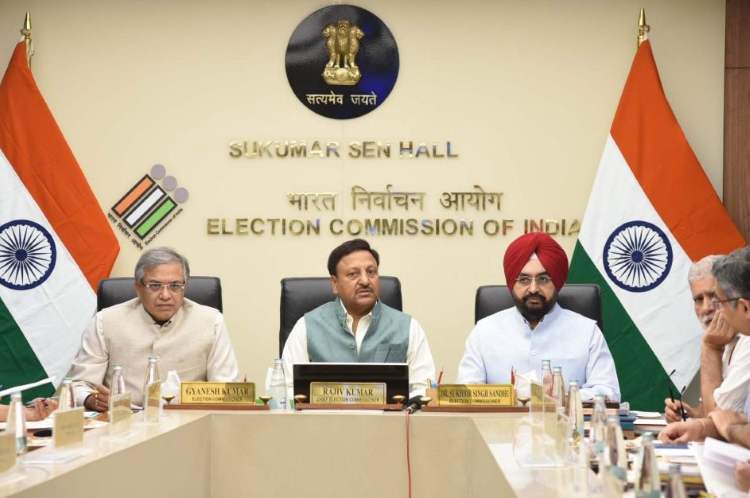
The recent controversy within the Election Commission of India (ECI) has raised questions that go beyond reported differences among the three Election Commissioners.
At its core is a more fundamental constitutional question of accountability as to who is accountable when significant electoral decisions are made, implemented, or administered within the Election Commission. The ECI has emphasised that differences of viewpoint are a normal feature of institutional decision-making and that the Commission functions through collective decision-making, including by majority where necessary.
This position may be consistent with the ECI’s own description of its functioning, but this controversy provides us an opportunity to examine whether India’s electoral framework provides sufficient transparency about how decisions are made and sufficient accountability for those who exercise authority within the Election Commission.
READ I Gen Z protests reshape student politics in India
Article 324(1) vests in the Election Commission the “superintendence, direction and control” of the preparation of electoral rolls and the conduct of elections to Parliament, State Legislatures and the offices of President and Vice-President. Article 324(2) provides for a Commission consisting of the Chief Election Commissioner and such number of other Election Commissioners as the President may determine.
Article 324(3) makes the Chief Election Commissioner the Chairman when other Election Commissioners are appointed. Article 324(5) gives the Chief Election Commissioner a special constitutional protection against removal, requiring the same manner and on the same grounds as applicable to a Judge of the Supreme Court. The constitutional framework therefore deliberately places the administration of elections in an institution designed to operate with a substantial degree of independence.
The Supreme Court has repeatedly recognised the breadth of the ECI’s powers under Article 324 but has also placed an important qualification on that power. In Mohinder Singh Gill v Chief Election Commissioner, the Court held that where Parliament or a state legislature has enacted valid electoral legislation, the Commission must act in conformity with it.
Article 324 supplements statutory law; it does not ordinarily permit the Commission to override legislation occupying the field. The Supreme Court reiterated this principle in 2026 while considering the ECI’s powers in relation to the revision of electoral rolls.
READ I Digital protest is reshaping democratic accountability beyond elections
Internal accountability of election commission
This makes the question of internal accountability particularly important. The public discussion about the ECI generally focuses on the Chief Election Commissioner and the two Election Commissioners. Yet the ECI is a much larger administrative institution.
The statutory framework recognises Chief Electoral Officers, District Election Officers, Electoral Registration Officers and Assistant Electoral Registration Officers, while the Commission itself states that it delegates some of its executive functions to officers within its Secretariat. The question, therefore, is not merely how the three Commissioners decide. It is also how authority travels through the institution.
A comprehensive delegation-of-powers framework would be a useful institutional reform. Citizens, political parties and civil society should be able to determine, subject to legitimate confidentiality requirements, which categories of decisions are reserved for the Commission collectively, which may be handled by individual Commissioners or the Chief Election Commissioner, and which may be delegated to senior officials.
The framework should also identify reporting relationships. Who should review another official’s delegated authority? If two levels of administration disagree, who resolves the disagreement? If a significant administrative decision is taken pursuant to delegated authority, where is that responsibility recorded? These questions become even more important because electoral administration is rapidly becoming digital.
The ECI has substantially expanded its use of technology across the electoral process. ECINET, launched in January 2026, is described by the Commission as a unified digital platform connecting citizens, candidates, political parties and election officials and bringing together a range of electoral services. The ECI already operates several digital systems for electoral registration, voter services, election permissions, election planning and other administrative functions.
The recent ECINET controversy is an important example of why this matters. Reporting in September 2026 indicated that Maharashtra Chief Electoral Officer S Chockalingam had sought changes to ECINET to enable Electoral Registration Officers to exercise certain discretionary powers that, according to the reporting, electoral law already confers on them.
The Election Commission subsequently accepted at least one of those requests, allowing EROs to exempt certain electors from personal hearings, and announced that ECINET would be reviewed by a committee headed by a senior Deputy Election Commissioner and including an independent technical expert from an IIT or IIIT.
The significance of this episode should not be overstated. It does not establish, by itself, that ECINET unlawfully transferred statutory authority from Electoral Registration Officers to software, neither does it establish that the ECI’s digital architecture was designed to circumvent electoral law. However, this controversy certainly demonstrates the constitutional relevance of software design where software becomes part of the mechanism through which statutory powers are exercised.
This is where the emerging perspective of digital constitutionalism offers a useful analytical framework. Traditional constitutional accountability asks who possesses public power, under what legal authority, and subject to what institutional constraints. In a digital administrative environment, the more important question is how is that power technically structured and implemented?
This also suggests that accountability should extend beyond the three Election Commissioners without undermining their constitutional independence. The 2023 Chief Election Commissioner and Other Election Commissioners Act already provides a statutory framework concerning the transaction of business by the Commission, while the ECI itself states that its business is conducted through meetings and circulation of papers and that executive functions are delegated to officers in its Secretariat.
Institutional objectives of ECI
The first requirement is greater transparency across the ECI’s rules of business, delegation orders and significant administrative procedures. The second is a clear accountability framework that follows the exercise of authority throughout the Commission’s administrative hierarchy.
The third is a governance framework for digital systems used in electoral administration, particularly where such systems affect statutory decision-making. The fourth is an auditable record of significant decisions that identifies the legal authority, institutional level, responsible official and applicable review mechanism.
None of these reforms requires weakening Article 324 or subjecting the ECI to routine external interference. Many safeguards already exist in law or have recently been strengthened. The need is to make them clearer, more systematic and transparent.
Clear lines of authority, recorded decisions and transparent delegation can make responsibility traceable and reduce uncertainty. Similarly, oversight of systems such as ECINET can help ensure that technology implements electoral law rather than inadvertently narrowing or expanding statutory discretion.
The objective is therefore not external control, but stronger institutional safeguards within the ECI itself. Institutional independence and transparency are therefore not competing values. When properly designed, they reinforce each other.
India needs an Election Commission that is independent without being opaque, powerful without being unaccountable, and autonomous while remaining transparent in the exercise of its constitutional powers.
The legitimacy of electoral administration depends not only upon whether votes are ultimately cast and counted, but also upon whether the institution administering elections can show who exercises power, under what authority, through what procedure and with what accountability with utmost constitutional fidelity and institutional practice.
Amit Upadhyay is Associate Professor, Jindal Global Law School, O. P. Jindal Global University, Sonipat, Haryana. Abhinav Mehrotra is Associate Professor, Jindal Global Law School, O. P. Jindal Global University, Sonipat, Haryana. Originally published under Creative Commons by 360info
