


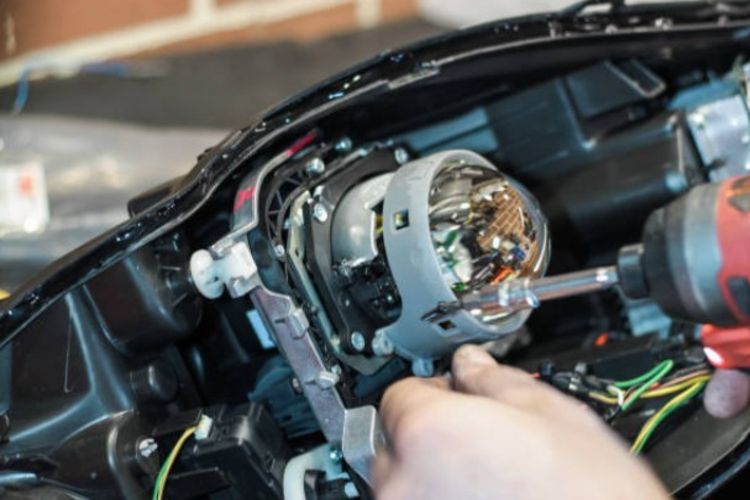
Delhi’s winter smog has a habit of turning marginal ideas into urgent policy debates. This year is no different. As air quality again slips into the “severe” zone, policymakers are reconsidering a proposal long treated as a technical curiosity- converting existing petrol, diesel and CNG vehicles into electric ones.
Known as electric vehicle (EV) retrofitting, the idea is suddenly being discussed as a pragmatic response to urban air pollution, stranded vehicle assets and the slow pace of EV replacement. If handled carefully, retrofitting could become a transitional tool in India’s clean mobility journey. If mishandled, it risks becoming another poorly regulated grey market.
READ | A retrofitting revolution can electrify India’s roads
What EV retrofitting actually means
Retrofitting replaces the internal combustion system of a vehicle—engine, fuel tank, exhaust and related components—with an electric drivetrain. The chassis and body remain intact, but propulsion shifts entirely to battery power. The appeal is straightforward. Retrofitting extends the usable life of a vehicle while eliminating tailpipe emissions. It also reduces operating costs for users who cannot afford new EVs. Unlike scrappage, which discards a functioning asset, retrofitting preserves embedded carbon already spent in manufacturing the vehicle.
India cannot scrap its way out of pollution
India’s vehicle fleet is both vast and young. Two-wheelers, three-wheelers and light commercial vehicles dominate urban mobility and livelihoods. According to government estimates, road transport contributes nearly 40% of Delhi’s PM2.5 emissions, with older vehicles bearing a disproportionate share.
Policy responses have focused on bans and scrappage. But scrapping is expensive for small operators and environmentally inefficient once lifecycle emissions are considered. For millions of households, replacing a vehicle is not an option. Retrofitting offers a third path: cleaner air without mass asset destruction.
READ | India’s energy security hinges on smart transitions
The economics is already compelling
For fleet owners and small businesses squeezed by tightening emission rules, retrofitting offers immediate relief. Instead of junking a usable vehicle, operators can extend its life at a fraction of replacement cost.
A 2024 JMK Research study estimates retrofit kit costs at around ₹50,000 for two-wheelers, ₹1–2 lakh for three-wheelers, and about ₹5 lakh for four-wheelers. Operating savings from lower fuel and maintenance costs often shorten payback periods to under three years for commercial users.
The potential scale is significant. Tsuyo Manufacturing, working with the Ministry of Electronics and Information Technology, estimates that 5–6 million commercial vehicles could be candidates for conversion annually. Its quoted conversion costs—₹1.25–1.3 lakh for three-wheelers and ₹3–3.25 lakh for light commercial vehicles, including batteries—are materially lower than buying new EVs.
Regulatory risk cannot be ignored
Policy enthusiasm, however, does not substitute for regulatory realism. EVs are integrated systems, not simple engine swaps. Battery management, thermal control and vehicle dynamics directly affect safety. Poorly executed conversions raise fire and reliability risks.
Less discussed is the question of who enforces quality at scale. Transport regulation in India is executed by state transport departments and RTOs, many of which are already stretched by routine compliance tasks. Without clearly designated testing agencies, post-conversion inspections, and penalties that can actually be enforced, standards risk remaining on paper. Retrofitting cannot be regulated through central advisories alone; it will succeed or fail on the administrative capacity of states.
Globally, regulators have moved cautiously. In Europe, retrofitting has focused on buses and municipal fleets rather than private cars. London’s electric bus retrofit programme cut emissions without full fleet replacement. France and Germany allow retrofitting under strict homologation standards and certified installers.
China followed a different path. During its early pollution crisis, cities permitted aggressive retrofitting of taxis and logistics vehicles. As EV manufacturing scaled and costs fell, regulators tightened standards and pivoted decisively to factory-built EVs. Retrofitting was allowed—but only as a time-bound, tightly supervised solution.
READ | EVs vs hybrids: Can the electric vehicle market survive without subsidies?
India needs rules, not bans or free-for-alls
India’s challenge is sharper because informality runs deeper and price sensitivity is higher. A blanket ban would push retrofitting underground. Unrestricted approval would invite safety failures.
Industry analysts broadly agree on a middle path. Retrofitting should be encouraged where benefits clearly outweigh risks—two-wheelers, three-wheelers, light commercial vehicles and city buses. Private passenger cars should remain a lower priority.
There is also a quieter constraint: insurance and finance. Many insurers remain cautious about underwriting retrofitted vehicles because liability is unclear in the event of battery failure or fire. Banks and NBFCs face similar uncertainty when valuing converted assets for loans. Without clear product-liability rules covering kit manufacturers and installers, retrofitting risks remaining a cash-only market, limiting adoption to larger fleet operators.
Policy signals, however, are inconsistent. Retrofitters face higher GST rates than new EVs, limited access to central subsidies, and fragmented state-level incentives. If retrofitting genuinely reduces pollution and resource waste, fiscal policy must reflect that assessment. Lower GST rates, incentives tied to certified kits, and faster approvals would formalise the sector and crowd out unsafe operators.
Retrofitting as a bridge, not a destination
India has begun moving toward standardisation by involving public institutions such as VNIT Nagpur in developing certified conversion kits, echoing European practice. This is the right direction.
One further constraint deserves attention: charging and electricity supply. Retrofitted vehicles, especially in commercial clusters, will concentrate demand in depots and neighbourhoods that may not be grid-ready. Without coordination with DISCOMs, time-of-day tariffs and local charging plans, retrofitting could strain urban distribution networks or shift emissions upstream. Clean mobility does not end at the vehicle; it depends on energy planning keeping pace.
Critics are correct that retrofitting cannot replace large-scale EV manufacturing. It risks locking in older platforms if used indiscriminately. But that is an argument for limits, not rejection.
Delhi’s pollution crisis has forced an uncomfortable but necessary debate. Retrofitting, done with firm standards and clear incentives, offers speed, affordability and environmental pragmatism. It is not the end point of India’s clean mobility transition—but it may be the fastest way out of the smog.