


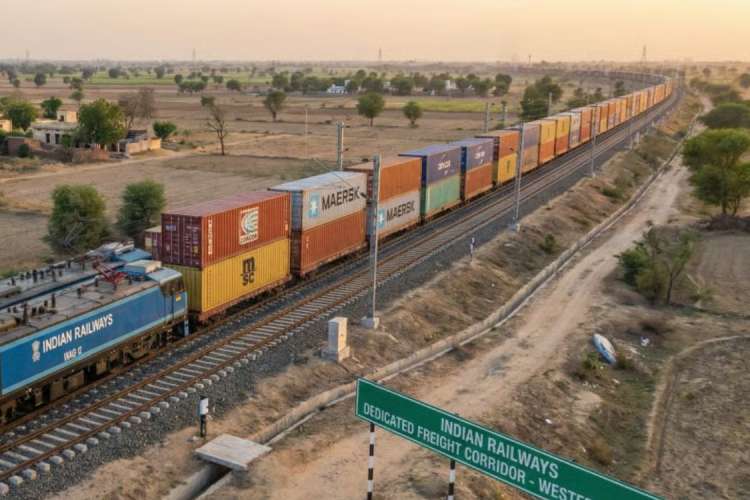
Western freight corridor: On September 8, Prime Minister Narendra Modi dedicated the last three sections of the Western Dedicated Freight Corridor, completing a railway project that has taken two decades to build. The 326 km commissioned between Gujarat and Maharashtra gives the 1,506 km corridor an uninterrupted connection from Dadri in Uttar Pradesh to Jawaharlal Nehru Port near Mumbai. Together with the 1,337 km Eastern DFC, India now has 2,843 km of dedicated freight railway. Completion is an engineering milestone. Whether it becomes an economic one will depend on what happens next.
Indian Railways has long asked freight and passenger trains to compete for the same track capacity. Passenger services generally get priority. Goods trains wait, schedules become uncertain and the advantages of rail are diluted. Dedicated freight lines remove much of this conflict. They are designed for speeds of up to 100 kmph, heavier axle loads and, on the Western corridor, double-stack container trains. For an economy that wants manufacturing and exports to carry a larger share of growth, this matters. But laying the track solves only one part of India’s freight problem.
READ | Indian Railways asset monetisation: Govt plans sale without loss of control
Western DFC changes the economics of freight
India now has a better measure of its logistics burden than the 13–14% of GDP figure that circulated for years without a sufficiently robust statistical basis. The DPIIT-NCAER assessment puts logistics costs at ₹24.01 lakh crore, or 7.97% of GDP, in 2023-24.
The same study shows why rail should have a larger role in long-distance freight. Average road transport costs are estimated at ₹3.78 per tonne-km, against ₹1.96 for rail. The ₹11.03 figure sometimes cited for road applies specifically to light trucks, not road haulage as a whole.
Those averages do not mean that every consignment becomes cheaper merely by putting it on a train. Rail needs terminals, handling, feeder connections and often a road journey at either end. The commercial question is whether the cost and reliability advantage on the long haul is large enough to compensate for those additional movements.
The Western DFC improves that equation. It links the industrial belt of northern and western India to the ports on the west coast, with the final connection bringing JNPA directly onto the dedicated network. JICA says the completed corridor links industrial centres across Uttar Pradesh, Haryana, Punjab, Rajasthan and Gujarat with Maharashtra’s port and logistics system.
READ | Indian Railways need accountability, not slogans
Western freight corridor: Reliability may matter more than top speed
Speed attracts attention because it is easily measured. Freight customers care at least as much about whether a shipment will arrive when promised.
That has been the weakness of freight on a railway system dominated by passenger traffic. A manufacturer can live with a 30-hour journey if it reliably takes 30 hours. A journey that alternates unpredictably between 25 and 45 hours forces firms to hold more inventory and build slack into production schedules.
Dedicated tracks should reduce that uncertainty. The corridors are already carrying substantial traffic. The Railways said in August that more than 443 freight trains were operating on the DFC network each day. It also reported higher average speeds and faster turnarounds after freight was shifted away from the conventional network.
The gain can spread beyond freight. Moving goods trains to dedicated tracks releases paths on the conventional railway for passenger and other freight services. That is one reason the economic return cannot be measured solely by revenue collected on DFC trains.
Still, capacity has to be converted into usage. The National Rail Plan seeks to raise rail’s share of freight to 45% by 2030, compared with roughly 27% now. The DFC gives the Railways the physical capacity to pursue that goal. It does not guarantee that shippers will make the switch.
The missing reform is outside the railway track
The gap between engineering potential and commercial gain is already visible.
Industry estimates cited after the JNPA connection suggest container train operators are currently getting cost benefits of roughly 6–7%, against an estimated potential of about 25%. Operators point to container regulations, tariffs and terminal charges as factors holding back the full saving.
That is an important warning. India can build a high-capacity freight railway and still lose much of the advantage at the interchange.
A factory without an efficient connection to a freight terminal will continue to depend heavily on trucks. A fast train entering a congested port does not create a fast supply chain. Nor will lower rail operating costs automatically reach exporters if tariffs and handling charges absorb the saving.
The next stage of logistics reform therefore lies in the interfaces between railways, ports, roads, logistics parks and private freight operators. This is harder work than commissioning infrastructure because responsibility is distributed across institutions. It involves pricing, terminal access, operating rules and investment by private firms.
READ | Vande Bharat trains redefine Indian railways – but at what cost?
The Western corridor makes the consequences particularly visible because its strongest commercial proposition is container traffic between the northern hinterland and western ports. If shippers see dependable schedules and meaningful door-to-door savings, traffic will migrate. If the advantage disappears in first- and last-mile costs, rail will struggle to take freight from road despite having superior trunk infrastructure.
Eastern DFC serves a different freight economy
The 1,337 km Eastern DFC has a different cargo profile. Coal, minerals and other bulk commodities are more important there. It also relieves some of the most heavily used conventional railway routes across northern India.
The distinction matters. India should resist treating every freight corridor as the same project repeated in another geography. Containerised export cargo, coal, steel, foodgrains and manufactured goods impose different requirements on terminals, wagon availability and service design.
The economics of each corridor must therefore be judged by the freight market it serves.
There is already a larger network in prospect. The Union Budget 2026 announced a new Dedicated Freight Corridor connecting Dankuni in the east with Surat in the west. The Railways says preparation and updating of the detailed project report has been taken up.
Before another large commitment is made, the first two corridors offer a useful laboratory. The question should not be how many kilometres India can add. It should be how much freight the corridors can shift, how reliably they can move it and how much of the resulting saving reaches businesses.
The Western DFC has supplied the railway. The task now is to build the logistics system around it.