


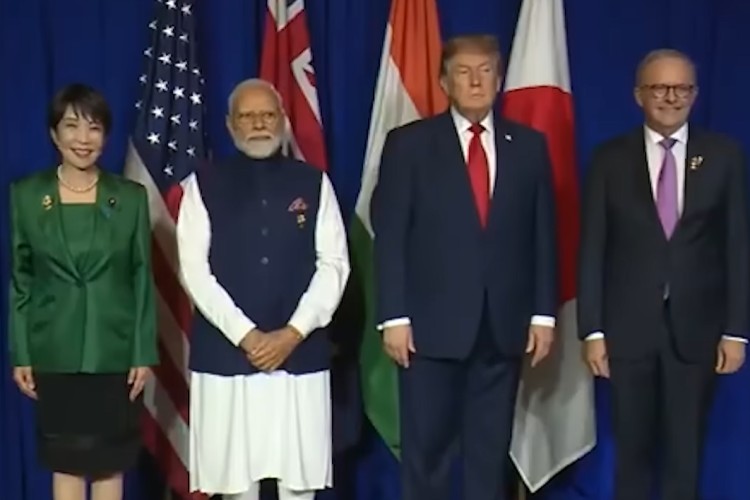
Quad Manila Summit pledges face a supply chain test: The leaders of Australia, India, Japan and the United States met in Manila on November 17 for the first Quad summit in more than two years. They backed initiatives on artificial intelligence, maritime surveillance and cybersecurity, and announced that Mumbai would host the first Quad Business Leaders’ Forum in early 2027. Their warning about economic coercion through arbitrary export restrictions carried a clear implication for China, which the joint statement left unnamed.
The harder task begins when a company has to decide where to put its next factory or sign a long-term supply contract. Governments agree that dependence on a handful of suppliers leaves industries exposed. Companies still have to make the economics of an alternative work. The Mumbai forum gives the Quad a chance to bring those two calculations closer together.
READ | How the US-China reset recasts the QUAD
China’s advantage runs through the supply chain
China’s manufacturing advantage is often put down to cost. A factory also draws on nearby suppliers, skilled workers and logistics networks built up over years. Moving final assembly to another country can give a company a second production base while leaving it dependent on many of the same suppliers. It is harder to move the network that makes the factory competitive.
Critical minerals illustrate the problem. Electric vehicles, renewable energy equipment and advanced electronics depend on minerals such as lithium, cobalt and graphite, as well as rare earth elements. A mineral can be mined in one country and still pass through China before a manufacturer can use it. The International Energy Agency’s 2026 outlook estimates that refining projects outside the dominant supplier face capital costs at least 20% higher, with the gap exceeding 150% in some cases. Operating costs are about 50% higher on average.
READ | Critical minerals central to Quad’s regional security plan
The Quad members have capabilities they could put together. Australia has mineral resources, Japan has industrial and processing expertise, the US can bring capital and technology, and India offers a growing manufacturing market. The commercial test is whether those strengths can support a project. A refinery needs a reliable source of feedstock and customers willing to sign contracts long enough to justify the investment. If buyers want a second source only when their existing supplier runs into trouble, the refinery will struggle to raise money.
What the Quad can do without a trade pact
The Quad has no common tariff schedule or shared market-access commitments. That flexibility lets members work together where their interests overlap. It also limits what they can offer companies weighing investments that depend on access to several markets. India remains cautious about opening its domestic market, and the United States gives priority to domestic production in strategic industries. Japan and Australia already work within regional trade agreements. A common Quad trade policy would be difficult to negotiate.
The Indo-Pacific Economic Framework for Prosperity offers a more specific lesson. Launched in 2022, it brought together 14 countries, including all four Quad members. It produced agreements on supply chains, clean economy and fair economy issues. The trade negotiations remained unfinished, and India stayed out of that pillar. With tariff concessions off the table, governments had less to offer in return for politically difficult commitments on trade rules.
READ | BRICS economic goals clash with India’s Quad strategy
The Quad can start with narrower commitments. A manufacturer considering two production sites would benefit from knowing whether both countries accept the same product tests and how long customs clearance is likely to take. A mineral processor needs some confidence that its customers will still be able to buy from it after a change in trade policy. These are matters governments can work on sector by sector.
Quad Manila Summit: Where the AI initiative can help
The Manila summit reaffirmed the AI accelerator announced by Quad foreign ministers in Atlanta on October 31. The ministers outlined more than $85 million in technical and financial assistance to widen access to AI across the Indo-Pacific. That sum is modest alongside the cost of building computing infrastructure. Its value will depend on whether it helps businesses and institutions in the region put AI to work.
India’s technology workforce gives it room to develop AI applications and build a market for their use in manufacturing. Japanese industrial firms could help test those applications in factories. US partners could provide access to computing resources and research. The members can judge the initiative by whether users can afford to keep these applications running once the initial assistance ends.
Southeast Asia has a stake in diversification
Vietnam, Indonesia, Malaysia and the Philippines have a place in any serious effort to diversify Indo-Pacific supply chains. Their manufacturers and logistics operators can help build commercially viable alternatives. These economies have extensive trade ties with China and have little reason to jeopardise them for the sake of joining a geopolitical initiative. An investment that brings local firms into a supply chain gives them a reason to participate on their own terms.
Mumbai is a chance to start with projects whose costs, buyers and obstacles can be identified. Take a critical minerals refinery. The prospective investors should be able to say who will supply it, who will buy its output and what still stands in the way of financing. If Quad governments can resolve even one of those problems, companies will have a reason to act on the concerns their leaders raised in Manila.