


India-US trade deal and farm imports: With India and the US moving from a February 7 joint statement to a signable interim trade pact, the near-term action is on tariffs and legal text, not farm market opening. Commerce Secretary Rajesh Agrawal said the US is expected to cut the existing 25% tariff on several Indian exports to 18% this week, and that any slippage will be taken up by the Indian team visiting Washington in the coming days. The stated aim is to close and sign the legal agreement in March 2026, though Agrawal cautioned that legal finalisation has its own intricacies.
That context is why agriculture has become the loudest political subtext of the deal despite being largely kept outside its core. The immediate anxiety was that wider market access for US farm goods would test India’s red lines in a sector already stressed by climate volatility, weak farmgate prices and low rural incomes. For now, those red lines hold.
Agriculture remains broadly outside the interim framework, with only a narrow set of imports seeing zero or reduced tariffs—specified fruits and nuts, wines and spirits, soybean oil, sorghum for animal fodder, and dried distillers’ grains. The India-US trade deal also flags preferential access for cotton varieties India already imports from the US, notably extra-long staple cotton alongside upland cotton.
READ I India-US tariff framework: What changes for exporters and imports
Agricultural imports are a small slice of India’s trade
Start with scale. Agricultural products account for about 5% of India’s total imports. Within that, the United States supplied roughly 6.5% of India’s agricultural imports in FY26 (April–December). That is the highest share in recent years, but still small in absolute terms. In other words, US farm imports amount to only a fraction of 1% of India’s total imports.
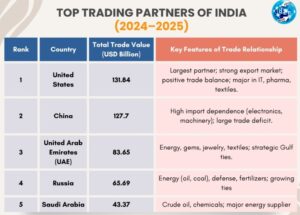

These numbers alone puncture the popular claim that American farm goods can flood the Indian market at scale. But aggregate statistics do not settle the issue. Farm politics in India is not driven by averages. It is driven by commodity-specific livelihoods, regional concentration, and rural price sensitivity. Small import volumes can still create outsized ripples when a commodity is politically salient or margins are thin.
READ I India-US trade framework: The coercion behind concessions
Commodity risk is concentrated, not economy-wide
The real test is product-by-product. Tree nuts show why not every import is a competitive threat. Nearly two-thirds of India’s imports of almonds, pistachios, and similar nuts come from the United States. India consumes large volumes, but domestic cultivation is limited by climate and agro-ecological constraints. In this case, imports fill a supply gap more than they displace Indian farmers. The adjustment, if any, shows up more in consumer prices than in farm incomes.
That logic does not hold for all categories. Edible oils and feed inputs are structurally different because they touch large domestic value chains.
READ I India-US trade deal: A pact with promise and plenty of fine print
India-US trade deal and edible oil imports
The proposed tariff reductions under the India-US trade deal cover soybean oil, sorghum used for animal feed, and dried distillers’ grains. Each sits in a market where India already relies on imports or where buyers are highly price-sensitive.
Edible oils are the clearest vulnerability. Imports account for well over half of domestic consumption. Additional access for US soybean oil could intensify competition for oilseed farmers, especially in soybean and mustard belts. Still, even here, the immediate impact may be capped. India’s import basket is dominated by palm oil from Indonesia and Malaysia, which continues to enjoy a strong cost edge relative to US oilseed exports.
Sorghum is a more localised risk. India produces roughly 4-5 million tonnes annually, but output is regionally concentrated and highly dependent on rainfall. If imported sorghum lands cheaper and more reliably, feed manufacturers may switch. The stress will show up in producing regions, not across the national farm economy.
India’s farm trade is export-heavy, import-cautious
India’s agricultural trade profile is asymmetric. It is a major exporter and a cautious importer. Agricultural exports routinely exceed $50 billion, led by rice, spices, sugar, marine products, tea, coffee, and processed foods. Imports are largely about filling consumption gaps, especially edible oils, pulses, and select high-value items.
In that structure, the United States remains a niche supplier. Southeast Asia, Africa, and Latin America dominate many import lines. A modest expansion of US access is unlikely to rewrite India’s agricultural trade balance. The deeper concern is not today’s flows. It is what concessions signal about tomorrow’s negotiating frontier.
The red lines are wheat, maize, dairy, and poultry
Farm organisations are not wrong to worry about precedent. Tariff cuts that look harmless in a narrow list can create expectations of a broader opening later. The most sensitive categories are also the most feared: wheat, maize, dairy, and poultry, where the US enjoys large productivity advantages.
The gap is structural. In several cereals, US productivity can be two to three times higher than India’s. Scale, subsidies, logistics, and integrated supply chains amplify that advantage. Even limited import volumes can influence domestic prices because farm profitability in India often rests on thin margins. When margins are thin, price signals travel fast.
The policy task is to separate symbolic concessions from systemic opening. A small tariff tweak is not the same as a market redesign. So far, negotiators on both sides appear to recognise that distinction. That is why agriculture remains largely outside the core of the interim framework.
Consumer welfare is part of the equation
The import debate often treats consumers as an afterthought. That is a mistake. Imports of high-value products such as almonds, apples, and specialty oils can smooth price spikes and broaden choices, especially for urban households. Lower-cost feed inputs can also reduce costs in poultry and livestock supply chains, which can ease pressure on meat, egg, and dairy prices.
Food price stability is a legitimate policy objective, particularly when inflation remains politically and fiscally costly. Imports can play a limited stabilising role, provided the state is clear about where it will not compromise on domestic producer resilience.
India-US trade deal and internal competitiveness
Even in the best-case negotiating outcome, imports are not the main constraint on Indian agriculture. The heavier drag is domestic: stagnant yields in key crops, inadequate irrigation coverage, fragmented marketing channels, large post-harvest losses, and slow adoption of improved seeds and mechanisation. These are not headline issues in trade talks, but they decide competitiveness.
Without addressing these constraints, Indian producers will face pressure not only from the United States, but from emerging agricultural exporters across Asia, Latin America, and Africa. Trade policy can buy time. It cannot substitute for productivity reform.