


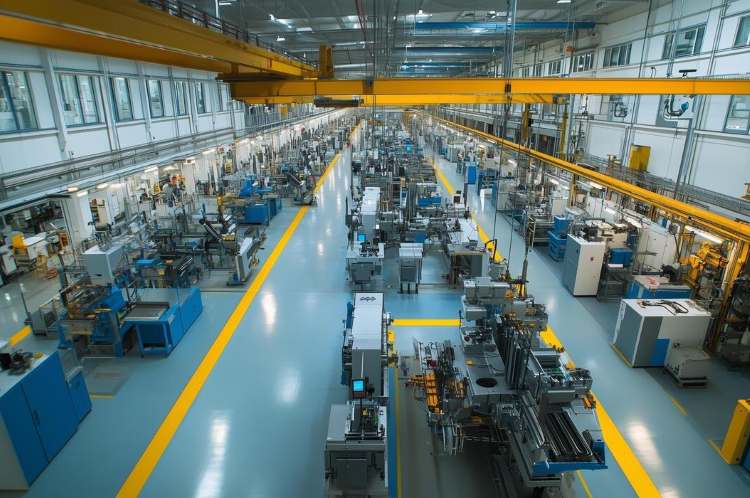
The strategic autonomy debate: India has scale, land, labour and a large domestic market. It is the world’s fifth-largest economy, but that ranking coexists with low per capita income and a weak employment base. Agriculture still accounts for a far larger share of employment than output, while manufacturing’s share in gross value added fell to 14.1% in 2023-24. Manufacturing employment was 11.4% of total employment in 2022-23. That is the central weakness in India’s growth structure.
Since Independence, India’s objectives have been clear enough: food security, strategic autonomy, and industrial development. On food, the country has travelled far. On strategic autonomy, too, India has tried to retain decision-making space through non-alignment first and multi-alignment later. But autonomy in foreign policy cannot survive economic vulnerability at home.
The present pressure comes from the overlap of trade and energy risk. India remains exposed to imported oil, and the vulnerability is structural rather than episodic. Official petroleum data show that Indian refineries continue to process overwhelmingly imported crude. In February 2024, for instance, refineries processed 18.8 million metric tonnes of imported crude out of 20.9 million metric tonnes in total. That is why oil shocks do not remain confined to diplomacy; they pass through inflation, transport costs, fertiliser subsidy, the current account and industrial competitiveness.
READ I Remittances to India rise as Iran war triggers panic transfers
Manufacturing capacity cannot be built on rhetoric
If India wants strategic autonomy, it must first build productive depth. The issue is not merely whether India imports too much. The issue is whether it can produce enough, at the right cost and quality, to reduce avoidable dependence and compete abroad.
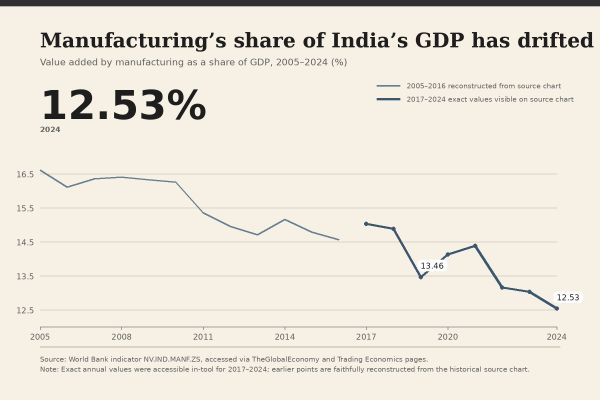

That is where the manufacturing gap becomes serious. A country that wants to employ its demographic surplus cannot remain stuck with a manufacturing share of 14.1% of GVA. Nor can it hope to become a manufacturing hub by relying on tariff walls and cheap labour alone. Production becomes globally competitive when firms face lower logistics costs, reliable power, quicker clearances, better port connectivity and predictable regulation. India’s improvement to rank 38 in the World Bank’s 2023 Logistics Performance Index is welcome, but the very fact that the policy goal is to reduce logistics costs to below 10% of GDP shows how much remains unfinished.
The domestic market is large enough to support scale. But scale without competitiveness only produces expensive import substitution. India has to do more than replace imports at home. It has to create firms that can survive in global value chains.
READ I Indian economy’s growth challenge is jobs, skills and state capacity
Education quality key to manufacturing capacity
The draft was right to place education near the centre of the argument. But the problem begins before university.
India’s graduate unemployability problem is not only a higher-education problem. It is the cumulative result of weak school foundations, uneven learning outcomes and poor alignment between education and work. ASER 2024 shows recovery in reading and arithmetic after the pandemic years, but the levels remain thin for a country that seeks industrial upgrading.

In government schools, only 44.8% of Std V children could read a Std II text in 2024, and at the all-India level only 30.7% of Std V children could do a numerical division problem. That is not a minor social-sector concern. It goes directly to labour productivity, trainability and future industrial capability.
The expansion of private universities has increased supply, not necessarily quality. The result is familiar: firms complain of graduates who need retraining before they can work productively. A country cannot talk of research, technology transfer and advanced manufacturing while neglecting foundational learning.
READ I Rising state debt: Welfare politics meets fiscal limits
Public health is economic capacity
The same logic applies to health. India’s health system has expanded in size, but the balance between public purpose and private provision remains unsettled. National Health Accounts for 2021-22 show that out-of-pocket expenditure still accounted for 39.4% of total health expenditure. Government health expenditure rose to 48% of total health expenditure, and government health spending reached 1.84% of GDP, but that still leaves households carrying a large burden.
That matters for growth. A healthy labour force is not a welfare add-on to development. It is part of development itself. Public systems under the National Health Mission need to work better at the primary and secondary levels, because a manufacturing economy cannot be built on fragile household finances and uneven access to care.
Demographic dividend needs women in workforce
Any discussion of India’s demographic dividend is incomplete without women’s work. The labour market has improved in recent years, and the female labour force participation rate for those aged 15 and above rose to 35.6% in 2023-24 on the current weekly status measure. But that still leaves India with a large untapped workforce, especially in urban areas, where female participation was only 26.1%.
This is not merely a social issue. It is an economic constraint. India cannot aspire to higher per capita income while a large part of its adult population remains weakly connected to paid work. Manufacturing, services and even modern agriculture will need more women in the workforce, backed by safer mobility, better skilling and lower care burdens.
Governance, federal trust shape economic outcomes
The original draft turns to the office of governor, and the link can be made clearer. Constitutional erosion is not a side issue when the economy depends so heavily on state implementation.
Manufacturing corridors, industrial land, power supply, skilling, school systems, hospitals and labour administration depend substantially on states. If the Centre-state relationship is weakened by politicised institutions, policy credibility suffers. The office of governor was never meant to become an extension of partisan management. The warnings of the Sarkaria and Punchhi commissions are relevant because federal trust is not ornamental. It affects investment, coordination and reform execution.
Strategic autonomy begins with per capita strength
India’s external autonomy will never be secured by diplomacy alone if its internal federal compact is frayed.
India has come a long way from famine and scarcity. It is a leading producer in several sectors, from milk and rice to steel and horticulture. But aggregate size is not enough. A country becomes strategically strong when its citizens are more productive, healthier, better educated and more securely employed.
That is why the real test is not whether India can make declarations on global peace, trade and sovereignty. It is whether India can raise per capita income on a durable basis by building manufacturing strength, reducing avoidable import dependence, improving school learning, strengthening public health and using its federal system as an asset rather than a battleground.
Strategic autonomy, in the end, is not a posture. It is capacity.