


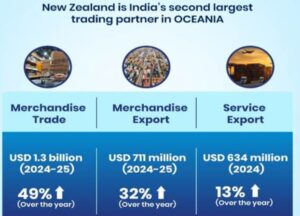
India-New Zealand FTA: India’s free trade agreement (FTA) with New Zealand will not move global trade numbers. With bilateral commerce at roughly $2.4 billion, it is small by any measure. Yet to judge the pact by volumes alone is to miss its significance. In a fragmented global trade order where trust is scarce and rules are weakening, agreements with smaller but institutionally strong economies carry strategic weight far beyond their market size. The New Zealand deal shows that India is recalibrating its trade strategy, away from tariff defensiveness and towards selective, credibility-building integration with advanced economies.
Modest deal with disproportionate value
Under the agreement, New Zealand has committed to zero-duty access for all Indian exports and pledged $20 billion in foreign direct investment over the next 15 years. This will not rival India’s trade with the US, the EU, or China. But it establishes an important precedent. India has demonstrated that it can conclude high-standard agreements with developed economies while ring-fencing politically sensitive sectors.
READ | India-EU FTA and CBAM: The coming carbon tax shock
The agreement’s real discipline lies not in what it opens, but in what it deliberately avoids. India has limited tariff concessions largely to non-sensitive industrial goods and retained wide policy space in agriculture by excluding dairy altogether. There is no sweeping opening of government procurement, no radical overhaul of data localisation rules, and no investor–state dispute settlement that constrains future regulation. This makes the deal strategically conservative. It delivers credibility without locking India into irreversible commitments. That restraint matters, because it signals that New Delhi is still sequencing liberalisation rather than embracing it wholesale.

For years, India’s trade policy oscillated between ambition and retreat, often marked by tariff hikes and stalled negotiations. The New Zealand pact suggests a more disciplined approach—one that prioritises reliability, legal clarity, and long-term integration over headline export surges.
Why OECD markets matter for India
New Zealand’s membership of the Organisation for Economic Co-operation and Development is not incidental. OECD economies are not merely richer markets; they are global standard-setters. Their rules on food safety, labour mobility, data governance, services trade, and investment protection increasingly shape global norms.
For Indian firms, preferential access to such markets is as much about learning to operate under demanding regulatory regimes as it is about selling goods. The New Zealand agreement will serve as a testing ground. Companies that succeed here will be better prepared to scale into other advanced markets where compliance, not price alone, determines competitiveness.
The pact also needs to be read against India’s unfinished trade agenda. Negotiations with the European Union remain slow and politically fraught, while the shadow of India’s exit from RCEP still hangs over its credibility in Asia. Smaller OECD agreements function, in effect, as rehearsal rounds. They allow India to test regulatory disciplines, services commitments, and mobility provisions in manageable settings before confronting the far more demanding negotiations that Europe or CPTPP-style frameworks will entail. Whether these deals become stepping stones or comfortable substitutes will depend on what follows.
READ | Why the India-EU FTA matters more than ever
Services, skills and mobility in focus
Unlike older trade agreements focused narrowly on goods, the India–New Zealand pact places services and mobility at its centre. Provisions on student mobility, post-study work, and temporary employment visas reflect India’s comparative advantage in skills and knowledge-intensive services.
This is a quiet but important shift. India’s export future lies less in bulk manufacturing and more in IT services, education, healthcare, design, and professional services. Agreements that enable the movement of people and capabilities, rather than just goods, align more closely with India’s evolving economic structure.
The virtue of small, rules-driven partners
Smaller OECD economies offer something that larger markets often do not: space for pragmatic compromise. The exclusion of dairy from the New Zealand agreement illustrates this. New Zealand is a global dairy powerhouse, but India’s dairy sector is politically and socially sensitive, supporting millions of small farmers. Wellington’s willingness to ring-fence the sector—while retaining a consultation mechanism—shows an appreciation of domestic constraints that has often been absent in negotiations with larger partners such as the US or the EU.
Union commerce minister Piyush Goyal has described this as India’s third deal with a “Five Eyes” country, after Australia and the UK. These agreements are not only about tariffs; they are also about alignment, trust, and predictability in an increasingly uncertain global system.
READ | India-EU FTA talks gain urgency under US trade pressure
Scepticism around India-New Zealand FTA
Scepticism is warranted. Trade agreements do not implement themselves. Ajay Srivastava of the Global Trade Research Initiative has rightly noted that the New Zealand pact is a framework rather than a breakthrough. The hard work begins after signing—building supply chains, meeting standards, and helping firms navigate unfamiliar regulatory terrain.
Execution will hinge less on diplomacy than on domestic preparedness. High-standard markets demand compliance, not promises. Many Indian MSMEs still struggle with certification costs, standards alignment, and logistics. Regulatory agencies—from food safety to professional services—remain uneven in their capacity to match OECD benchmarks. India’s past experience with underutilised FTAs, from ASEAN to Japan, offers a cautionary tale. Without parallel investment in domestic regulatory capability and exporter support, even well-crafted agreements risk becoming symbolic rather than transformative.
A quiet but deliberate shift
The $20-billion investment commitment also deserves attention. OECD investors tend to be patient, regulation-conscious, and technology-oriented. Attracting them requires assurance as much as incentives. A carefully designed FTA helps provide that assurance by locking in predictability and credible dispute-resolution mechanisms.
India’s renewed engagement with smaller OECD economies reflects a sober reading of global realities. The era of easy multilateralism has faded. Large powers are increasingly protectionist and transactional. In this environment, selective and strategic bilateralism offers a workable alternative.
The New Zealand agreement will not dominate headlines for long. But it adds another brick to a trade architecture that values quality of integration over sheer scale. For India, that may prove to be the more durable path.