


High-seas fishing push: India has spent years talking about the blue economy while most of its fishing fleet has stayed close to shore. That constraint is now being tested. On July 9, the government distributed Letters of Authorisation to fisheries cooperatives and vessel owners, allowing eligible Indian-flagged vessels to undertake regulated fishing in the high seas. The new regime creates a legal route to waters that Indian fishers have barely exploited.
The opportunity is substantial. India has an 11,099 km coastline and 24 lakh sq km of exclusive economic zone. Most fishing activity happens within 40-50 nautical miles of the coast. India is the world’s second-largest fish producer, but its presence in some of the most valuable oceanic fisheries remains negligible.
READ | Addressing livelihood issues of fisherfolk during fishing ban
The LoA addresses the legal barrier to high-seas fishing. Whether fishing communities can make money from distant waters will depend on the economics of the voyage, the quality of the catch when it reaches shore and the price ultimately obtained from buyers.
Moving beyond coastal fisheries
Fishing within India’s EEZ and fishing on the high seas fall under different legal regimes. India’s rights over marine resources extend up to 200 nautical miles from the coast. Beyond national jurisdiction, Indian vessels must operate according to international conservation rules as well as domestic requirements governing Indian-flagged vessels.
The government notified rules in 2025 for sustainable fishing within the EEZ and created a separate framework for operations on the high seas. An LoA is tied to a particular vessel, cannot be transferred and is linked to the ReALCraft registration system. Vessels operating under it must comply with the conservation and reporting requirements prescribed by the relevant Regional Fisheries Management Organisations.
These requirements give India a mechanism to identify vessels operating in distant waters and trace their catch. Such records are increasingly important in international seafood trade, particularly in markets that demand evidence on the origin and legality of fish.
Regulation, however, solves only the first problem facing an industry that has little experience of long-distance commercial fishing. An operator must acquire or modify a vessel capable of remaining at sea for extended periods, finance the voyage and preserve the fish well enough to meet export standards after it is landed.
READ | India’s rare earth push needs more than strategic urgency
Can tuna support the economics?
India has a large seafood export business. Exports touched a record ₹73,890.46 crore in 2025-26, when nearly 19.72 lakh tonnes of marine products were shipped. Fisheries programmes attracted more than ₹39,000 crore of public investment in the last 10 years.
Marine production also remains below the estimated capture potential of India’s EEZ. The department of fisheries puts annual capture potential at 5.31 million tonne. Marine capture production stood at 4.5 lakh tonnes in 2023-24. Fish stocks vary considerably by species and location, and sustainable catch depends on the condition of each stock.
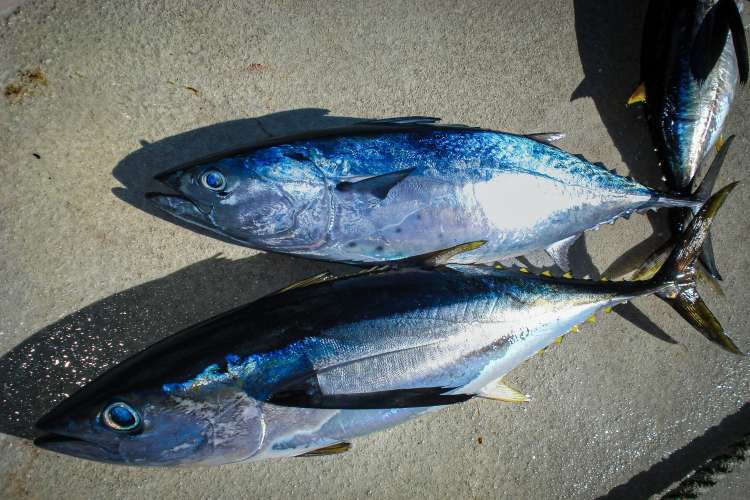
Tuna offers a clearer indication of the commercial possibilities farther offshore. India reported a tropical tuna catch of 60,530 tonnes in 2024. Yellowfin accounted for 29,141 tonnes and skipjack for 30,943 tonnes. Bigeye tuna accounted for only 446 tonnes.
Indian vessels have access to productive Indian Ocean fishing grounds, but distance changes the cost structure of the business. The benchmark unit cost for a deep-sea fishing vessel is ₹1.2 crore. Subsidies reduce part of the initial investment, but operators still have to fund fuel, maintenance and the working capital needed for longer voyages.
Small operators may struggle to meet the costs, particularly when revenue arrives only after the catch is sold. Cooperatives and Fish Farmer Producer Organisations could help pool investment and improve bargaining power, but their commercial viability will depend on how often vessels sail, the catch realised and the price received.
A policy that finances expensive boats without creating viable fishing businesses would leave communities carrying assets whose operating costs they cannot sustain.
More catch will not guarantee more export income
The condition of a tuna when it reaches the buyer can determine much of its value. Fish intended for premium markets has to be handled correctly on board and kept at suitable temperatures through landing, transport and processing. A long voyage can destroy much of the commercial advantage of an expensive catch if the cold chain fails.
India’s opportunity therefore extends beyond increasing landings. If vessels bring back more tuna only for it to leave the country as relatively low-value frozen fish, processors and brands elsewhere will retain a large share of the final value.
Greater domestic processing could change those economics. Exporters can obtain higher returns from products prepared to buyer specifications, provided fishing vessels and processors can maintain consistent quality. That requires investment at fishing harbours and closer commercial links between vessel operators and seafood companies.
This should also influence the way government support is designed. Subsidising vessel purchase is easier than developing the commercial network needed to keep vessels working profitably. Credit structures have to accommodate long voyages and uncertain catches. Harbour infrastructure has to handle high-quality fish quickly. Buyers need confidence that Indian suppliers can deliver the grades and quantities promised.
These are business conditions rather than administrative ones, and they will determine how much of the value generated by distant-water fishing stays with Indian fishing communities.
READ | Maritime India Vision looks to deliver a blue economy boom
High-seas fishing: Fish stocks impose their own limits
Expansion also has to remain within the biological limits of the Indian Ocean. Tuna stocks move across national jurisdictions and the high seas, which is why catches are governed through the Indian Ocean Tuna Commission and other international arrangements.
The IOTC’s 2025 assessment of bigeye tuna found the stock overfished, although fishing mortality on the central estimate was below the level associated with overfishing. The assessment put the probability that 2024 spawning biomass was below the level capable of supporting maximum sustainable yield at 54 per cent. It also recorded catches above the total allowable catch then in force.
India is entering distant-water fishing at a time when some of the species with the greatest commercial value are already subject to conservation constraints. Future fleet expansion will therefore have to follow stock assessments and catch rules closely. Catching more fish in the first few years would provide little economic gain if weaker stocks eventually force severe restrictions on fishing effort.
The LoA regime gives India something it previously lacked: a regulated route into high-seas fisheries. Its success will be visible in the businesses that emerge from it. If Indian fishers can earn more from each voyage, processors retain a larger share of the final value and catches remain within scientific limits, the policy could broaden India’s seafood economy. If vessel numbers grow faster than commercially viable fishing opportunities, permits and subsidies will have accomplished very little.