


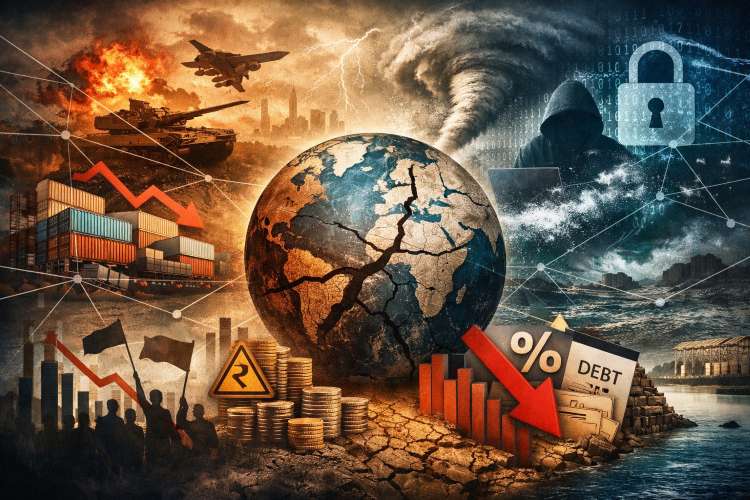
The World Economic Forum’s Global Risks Report 2026 offers a blunt diagnosis. The dominant risks facing the global economy are no longer discrete or episodic. They reinforce one another. Local shocks travel quickly. Structural fractures show up as lived risks.
At the top of the risk rankings by the Global Risks Report 2026 sits geoeconomic confrontation. Trade, finance, and technology have become arenas of contest. Governments now deploy tariffs, sanctions, export controls, and industrial subsidies as instruments of statecraft. The report’s Global Risks Perception Survey suggests that economic coercion increasingly rivals military force. After decades of globalisation, the pivot towards protectionism is unmistakable. Supply chains designed for efficiency are being rebuilt for security. The result is higher costs and weaker growth.
Close behind is the risk of interstate conflict. Expectations that 2026 would bring de-escalation have not held. From Europe to West Asia and the Indo-Pacific, unresolved disputes are intensifying amid great power rivalry. The report points to the spread of proxy wars, grey-zone tactics, and military brinkmanship. For India, state-based armed conflict ranks among the top five risks.
READ I Global economy’s 2026 optimism masks deep fault lines
Climate risk is lived reality
Extreme weather is now firmly embedded in the top tier of global risks. Climate change has moved from projection to experience. Heatwaves, floods, droughts, and storms are disrupting food systems and straining vulnerable populations. The Global Risks Report 2026 underlines the feedback loop at work: climate shocks deepen inequality and social stress, which in turn weaken the political and institutional capacity needed to respond.
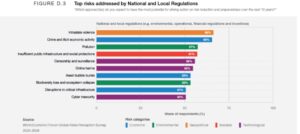

For India, among the world’s most climate-vulnerable large economies, the exposure is acute. The past year saw record heatwave days, fatalities, and water shortages across several states. Climate risk is no longer peripheral to economic planning. It is central.
READ I Gold prices reflect global distrust in dollar, US policy
Societal polarisation and erosion of trust
Societal polarisation has emerged as a major destabiliser. Inequality, identity politics, migration pressures, and cultural anxiety are widening internal divides. As trust in institutions erodes, the space for compromise narrows. Governments struggle to build consensus. Even routine policy choices provoke conflict, weakening governance and slowing reform.
Misinformation and disinformation amplify these pressures. Platform-driven amplification and algorithmic incentives have accelerated the spread of falsehoods, distorting debate and corroding trust. The Global Risks Report 2026 warns that manipulated information can influence elections, inflame conflict, and undermine public health responses. Generative artificial intelligence has raised the stakes by blurring the boundary between authentic and fabricated content.
READ I American hegemony is losing what once made it endure
Cyber insecurity in a digitised economy
For India, cyber insecurity stands out as the most prominent technology-linked risk. Rapid digitisation has transformed payments, service delivery, and governance. It has also expanded vulnerabilities. As critical infrastructure moves online, the attack surface grows. The report nevertheless identifies India’s digital public infrastructure as part of the answer, citing the Unified Payments Interface (UPI) as an example of how interoperable systems can combine scale with inclusion.
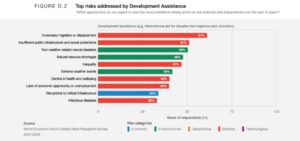

Inequality remains a persistent systemic risk. India’s growth and poverty reduction record is substantial, but uneven. Wealth concentration has increased, and employment creation has lagged. The report treats inequality not as a social by-product but as a force multiplier that intensifies other risks.
Public service gaps compound this strain. Shortfalls in healthcare, education, urban infrastructure, and social protection limit mobility and leave households exposed to shocks. Without sustained investment in public goods, growth alone cannot deliver social stability.
Global Risks Report 2026 highlights fiscal stress
What sharpens these risks is constrained fiscal capacity. High public debt, tighter global financial conditions, and elevated borrowing costs limit the ability of governments to respond when shocks hit. Climate adaptation, defence readiness, cyber security, and social protection all compete for scarce budgetary space.
The report notes that repeated crises have eroded fiscal buffers across advanced and emerging economies alike. When states lack the resources to act decisively, shocks last longer, trust erodes faster, and policy credibility weakens. Fiscal stress becomes the channel through which disparate risks harden into systemic instability.
Economic downturn risks loom against subdued global growth and tight financial conditions. Emerging economies face hard trade-offs between fiscal consolidation and social spending as external shocks multiply. The report links this vulnerability to the weakening of multilateral institutions, strained by declining trust, reduced transparency, and rising protectionism.
Water security and geopolitical flashpoints
Water security adds an environmental and geopolitical dimension. As climate variability intensifies, rivers and aquifers are becoming strategic assets. Upstream control can tempt unilateral action, raising tensions downstream. The Indus basin, shared by India and Pakistan, is flagged as a potential flashpoint in the coming decade. Resource stress rarely remains technical for long.
Running through these risks is a deeper crisis of trust. Diminishing transparency, weakened respect for the rule of law, and the retreat from cooperation are hollowing out the foundations of collective action. As Børge Brende observes in the World Economic Forum report, a more competitive global order is taking shape.
It may recognise geopolitical realities, but it cannot function without dialogue. The challenge for 2026 is not managing risks in isolation, but arresting the feedback loops that push an already fragile world closer to the edge.