


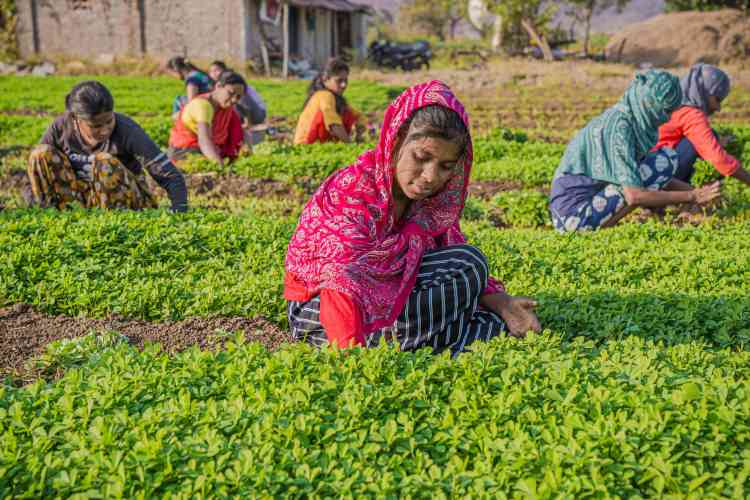
e-Shram data: At 5 am, 29-year-old Rajni begins with housework before leaving her one-room home to work in three or four homes. She cleans utensils, mops floors and cooks breakfast. By afternoon, she is back home to cook lunch and help her children with schoolwork. Some evenings, she takes extra work.
For years, Rajni, who lives in Rohtak, Haryana, described her occupation as gharo me kaam (house help). The families she worked for called her a maid, not a worker. Last year, during a local registration drive, she enrolled on the government’s e-Shram portal as a domestic worker. Her work did not change. Nor did her wage. The state, however, now counts her as a worker.
READ | Subhadra Yojana: Odisha’s cash scheme lacks power
e-Shram women registrations and invisible work
Rajni’s registration sits inside a larger shift. Women accounted for 68.78% of new e-Shram registrations in FY26, up from 52.38% in FY23 and 68.05% in FY25, according to Labour Ministry data reported by Business Standard. That is not proof that women are entering employment at the same pace. It is also evidence that women who were already working outside formal records are being put on a government database.
The e-Shram portal, launched in August 2021, is the Centre’s national database for unorganised workers. It covers domestic workers, agricultural labourers, street vendors, construction workers, gig workers and the self-employed. By March 3, 2025, 30.68 crore workers had registered, of whom 53.68% were women. The Labour Ministry has also linked 13 welfare schemes to the portal.
The occupational pattern explains the gender split. Women account for 65.54% of agricultural worker registrations on e-Shram, 93.66% of domestic and household work registrations, and 95.86% in apparel. Their share is also high in education, beauty and wellness, gems and jewellery, office administration, facility management, health care, leather, tourism, and hospitality.
Women workers remain trapped in informal employment
The e-Shram data should be read with care. It records a worker’s existence. It does not record a decent job. A domestic worker with an e-Shram card can still have irregular income, no paid leave, no maternity support, no pension contribution and no bargaining power.
India’s measurement problem is old. Millions of women work on family farms, tend livestock, make food products, stitch garments, run home kitchens, sell through WhatsApp or Instagram, or help in family shops. Many still describe themselves as housewives because their work does not resemble a salaried job. The official category catches them late, if at all.
READ | Women micro-entrepreneurs need markets beyond credit
The Time Use Survey 2024 shows the gap between work and recognition. Among those aged 15-59, 25% of women participated in employment-related activities during the 24-hour reference period, up from 21.8% in 2019. But 41% of women in that age group also participated in caregiving for household members, compared with 21.4% of men. Female participants spent 140 minutes a day on caregiving, against 74 minutes for male participants.
The same survey found that 81.5% of women aged six and above performed unpaid domestic services for household members, compared with 27.1% of men. Female participants spent 289 minutes a day on such unpaid domestic work; male participants spent 88 minutes.
Female labour force participation needs better jobs
The female labour force participation rate has risen. In the PLFS Annual Report 2025, the usual-status LFPR for women aged 15 and above stood at 40%, while the female worker population ratio was 38.8%. But the composition remains weak. Women are still concentrated in self-employment, household enterprises and low-paid informal work. PLFS 2025 put the female self-employment share at 64.2%, lower than 66.5% in 2024 but still high.
READ | Women entrepreneurs grow, but labour gaps persist
Marriage, childbirth and unpaid care still pull educated women out of paid work. PLFS 2025 found that 44.4% of women outside the labour force cited child care, personal commitments or home-making as the main reason. That number says more about the household economy than any exhortation to women to work.
The e-Shram numbers, therefore, are a useful correction to the official picture. They show that many women were never outside work. They were outside recognition. The portal can help only if registration leads to insurance, pension access, health cover, skilling, credit and enforceable protection in the jobs women actually do.
Counting Rajni is administrative progress. It is not labour-market progress until the worker on the database is paid better, insured and less dependent on the goodwill of the household that employs her.