


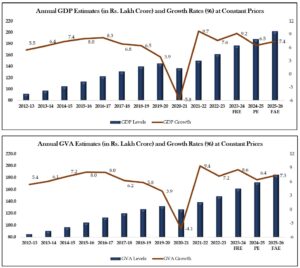
India will enter Budget 2026 with a reassuring headline. The economy is growing faster than most large peers. The NSO has projected real GDP growth of 7.4% in FY26, driven largely by services and steady public investment. Yet beneath this momentum lies a widening fault line that the budget can no longer sidestep: income inequality, especially between urban and rural India.
This matters now for three reasons. First, agriculture and allied activities, which still employ over 40% of the workforce, are growing at barely 3.1%. This is less than half the pace of the overall economy. Second, private consumption — nearly 60% of GDP — is showing signs of stress outside urban centres. Third, fiscal consolidation has narrowed the room for error. If growth is to remain durable, Budget 2026 must address the structural sources of rural income stagnation, not merely its symptoms.
READ I Indian economy: Growth brings prestige — and expectations
Growth is services-led, incomes are not
The current growth cycle is sharply skewed. According to the National Statistics Office, tertiary sector GVA is expected to grow by 9.9% in FY26, led by finance, real estate, and public administration. Manufacturing and construction are growing at a respectable 7%. Agriculture, by contrast, remains stuck in low single digits.
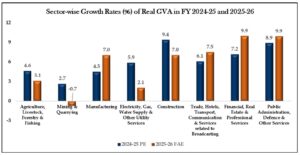

This divergence has direct income implications. Services growth is concentrated in skill-intensive urban activities. Agriculture employs more people than manufacturing and services combined, yet contributes less than 18% of GVA. The result is predictable: rising average incomes alongside stagnant median incomes in rural India.

The Reserve Bank of India has repeatedly flagged this imbalance. Its household surveys show urban consumption recovering faster than rural demand, while real wage growth for agricultural labour has lagged inflation in several states. A growth strategy that leaves such a large share of the workforce behind risks becoming self-limiting.
READ I Why sustainable finance is central to India’s economy
Rural wages and farm incomes under strain
The slowdown in farm income growth is not cyclical alone. It reflects deeper structural pressures. Minimum Support Prices have risen, but procurement remains concentrated in a few crops and states. According to the Reserve Bank of India, real agricultural wages have seen uneven growth since the pandemic, with gains eroded by food inflation in FY24 and FY25.
The World Bank’s latest poverty and equity assessments underline the same point. While extreme poverty has declined, vulnerability has increased for households dependent on agriculture and informal rural work. Small and marginal farmers—who account for nearly 85% of landholdings—remain exposed to climate shocks, price volatility, and rising input costs.
The upcoming Budget will therefore need to shift focus from headline support to income stability. This means expanding price-deficiency payment schemes beyond pilots, improving crop diversification incentives, and investing in storage and local processing to reduce distress sales. These are fiscal choices, not merely administrative ones.
READ I Global economy’s 2026 optimism masks deep fault lines
Consumption growth needs purchasing power
Private Final Consumption Expenditure is projected to grow 7% in FY26, roughly in line with GDP. But aggregate numbers mask divergence. Urban consumption is supported by salaried employment and asset appreciation. Rural consumption depends on volatile farm incomes and public transfers.
Evidence from the World Bank shows that inequality dampens consumption multipliers. When income gains accrue disproportionately to higher earners, incremental spending falls. For India, this is a macroeconomic risk. Sustaining an investment-led cycle without broad-based consumption support will be difficult.
Programmes such as PM-KISAN and MGNREGS have provided crucial buffers, but allocations have not kept pace with rural cost pressures. Budget 2026 will need to recalibrate rural spending—not as welfare, but as demand support. Strengthening MGNREGS with timely payments and indexing PM-KISAN transfers to inflation would be fiscally modest but economically meaningful steps.
Public investment alone cannot close the gap
Public capital expenditure has been the backbone of recent growth. Roads, railways, and logistics investments have lifted construction output and improved connectivity. But infrastructure spending does not automatically translate into higher rural incomes unless complemented by labour-intensive activities.
Manufacturing growth at 7% is welcome, yet its employment elasticity remains weak. Most new investment is capital-intensive. Without targeted incentives for agro-processing, food logistics, and rural MSMEs, the employment dividend will remain limited.
This is where Budget 2026 must make a strategic choice. Redirecting a portion of capital subsidies toward employment-linked incentives in rural districts could yield higher income multipliers. Policy Circle has previously argued for such recalibration in its analysis of employment-centric growth strategies (internal link suggestion: Policy Circle | Employment and Growth).
Inequality is also a fiscal risk
Rising inequality has direct fiscal consequences. When income growth is uneven, tax buoyancy becomes fragile. Consumption taxes underperform, while pressure mounts for higher subsidies. The IMF has warned that unequal growth paths increase fiscal stress over time by narrowing the tax base and amplifying political demands for redistribution.
India’s nominal GDP is projected to grow just 8% in FY26, reflecting lower inflation. This limits revenue headroom. Budget 2026 cannot rely indefinitely on expenditure compression or off-budget adjustments. Addressing inequality at source—by raising rural incomes—strengthens fiscal sustainability rather than undermining it.
This requires better targeting, not larger deficits. Rationalising regressive tax expenditures, improving GST compliance in high-margin services, and redirecting savings toward rural productivity would align equity with prudence.
Budget 2026 will be a test of intent
Budget 2026 will be framed amid global uncertainty and domestic optimism. The temptation will be to showcase growth and stability. But durable growth requires distributional balance. Ignoring rural income inequality would amount to mistaking momentum for resilience.
The policy takeaway is clear. India does not need a return to untargeted subsidies. It needs a budget that treats rural income growth as a macroeconomic priority. Price stability for farmers, employment-linked incentives, and inflation-indexed transfers are not populist choices. They are growth insurance.
If Budget 2026 fails this test, the costs will surface quietly—in weaker consumption, fiscal strain, and a narrowing growth base. By then, course correction will be harder and more expensive.