


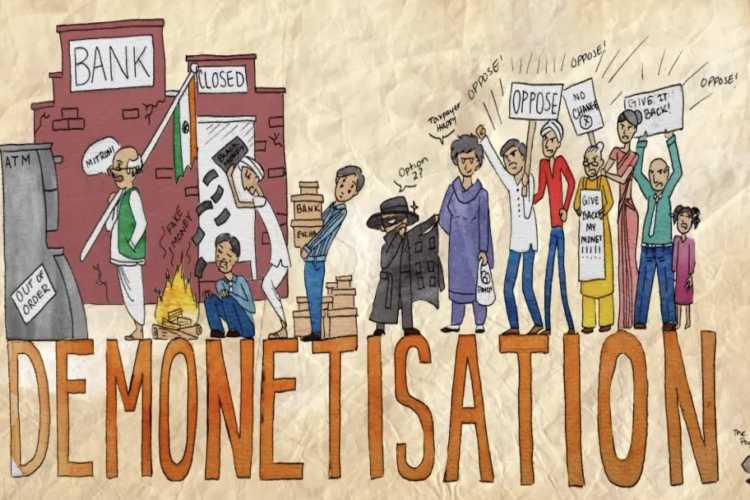
Ten years ago, when Prime Minister Narendra Modi announced that ₹500 and ₹1,000 notes would cease to be legal tender, the decision was hailed as a masterstroke against black money. A decade later, the evidence suggests that withdrawing currency is a poor way of tackling unaccounted wealth. Black money can change form, find new channels or move into assets that are harder to trace. That may be the most enduring lesson from India’s demonetisation experiment.
Since November 8, 2016, India has strengthened its digital payments system, expanded its tax network and improved financial surveillance. Yet questions remain about the effectiveness of demonetisation in achieving its original objectives. The withdrawn notes accounted for approximately 86% of the value of currency in circulation. The government identified eliminating black money, curbing counterfeit currency and disrupting terror financing as the principal goals. It expected that people holding large quantities of undeclared cash would either lose their money or expose themselves to tax scrutiny by depositing it in banks.
READ | SC upholds demonetisation, but cash is still king
The Economic Survey of 2016-17 subsequently described demonetisation as a radical and unprecedented measure with short-term costs and potential long-term benefits. The policy, however, rested on a questionable assumption about the nature of black wealth. Cash is only one of the ways in which undeclared income is held. Much of it finds its way into property, gold, businesses and financial assets.
What happened to the demonetised currency
The first indication of the problem came from the Reserve Bank of India’s annual report for 2016-17. Of the ₹15.44 lakh crore in demonetised currency, approximately ₹15.28 lakh crore had returned to the banking system. The RBI’s final reconciliation, published in its 2017-18 annual report, showed that ₹15.31 lakh crore of the ₹15.42 lakh crore withdrawn had returned. That amounted to 99.3% of the currency withdrawn. The expectation that substantial amounts of undeclared cash would become worthless proved unfounded.
The exercise did produce information for tax authorities. Deposits that appeared inconsistent with declared incomes were investigated, and the government reported searches, seizures and admissions of undisclosed income. In a February 2023 parliamentary reply, the finance ministry said that between November 2016 and March 2017, the Income Tax Department conducted search and seizure operations in 900 groups, seized assets worth ₹900 crore and recorded admissions of undisclosed income amounting to approximately ₹7,961 crore.
These figures establish that demonetisation helped identify some undeclared income. They do not tell us how much black wealth was recovered as a direct consequence of the exercise. Equally, the return of almost all the withdrawn currency does not establish that every rupee was legitimate. Deposits provided an opportunity for scrutiny, but there is little credible evidence that demonetisation brought about a lasting reduction in the generation of unaccounted income.
The economic costs of demonetisation
The economic costs were considerable. Withdrawing 86% of the value of currency in circulation almost overnight caused a severe liquidity shock in an economy where cash was essential for everyday transactions. Small businesses, daily-wage workers, elderly people and informal-sector employees bore much of the burden. Many had limited access to alternative payment systems or the working capital needed to withstand a prolonged cash shortage.
READ | Five years of demonetisation: Economy is highly digitised, but cash remains the king
Research by economists Gabriel Chodorow-Reich, Gita Gopinath, Prachi Mishra and Abhinav Narayanan, published in the Quarterly Journal of Economics, found that districts more severely affected by demonetisation experienced declines in economic activity, employment and bank credit. Their estimates suggest that the cash shortage reduced employment and output, measured through night-time light intensity, by at least two percentage points in the fourth quarter of 2016 relative to what would otherwise have occurred. The effects gradually dissipated, but the immediate disruption was substantial.
The slow pace of remonetisation compounded the problem. According to the RBI’s 2016-17 annual report, the central bank pumped 23.8 billion currency notes worth ₹5.54 lakh crore into circulation between November 9 and December 31, 2016. Restoring an adequate supply of currency took much longer. Businesses and households were left to cope with the uncertainty, often at considerable financial cost.
There were gains in tax compliance and formalisation during this period. Income tax filings increased, suspicious deposits became more visible and digital payments received a significant push. The finance ministry reported that income tax returns filed during 2017-18 increased by 25%, while net direct tax collections grew by 18%.
These developments deserve recognition, although their connection with demonetisation is difficult to establish. Digital payments had been growing before November 2016, and the introduction of the Goods and Services Tax in July 2017 brought more transactions into the formal economy. Improvements in tax administration and digital infrastructure also contributed to the expansion of the tax base. Demonetisation may have accelerated some of these changes, but the available evidence does not allow its contribution to be isolated with confidence.
READ | Worth the trouble? Indian economy will gain from long-term effects of demonetisation
Why demonetisation could not eliminate black money
If the objective was to reduce black money, the government needed to address the sectors and institutions that facilitate its generation. Real estate, for instance, has long provided opportunities for converting undeclared income into assets. Under-reporting of property values, cash components in transactions and opaque ownership structures make it possible to conceal income and evade taxes.
The government’s own White Paper on Black Money, published in 2012, identified real estate, bullion and jewellery among the sectors associated with unaccounted wealth. Demonetisation left many of the practices that sustain such transactions largely untouched. Individuals and businesses could continue to generate undeclared income through under-invoicing, false accounting, benami transactions and corruption in public procurement.
Nor does the spread of digital payments necessarily make the economy transparent. Electronic transactions leave records that can help tax authorities. But those records are of limited use when transactions are deliberately misreported, ownership is concealed or accounts are falsified. Effective enforcement depends on the ability of institutions to detect discrepancies, investigate wrongdoing and impose penalties.
Supporters of demonetisation have argued that it brought previously unaccounted cash into banks, expanded the tax base and encouraged digital payments. There is some substance to these claims. The difficulty lies in assessing whether the gains justified the enormous disruption, particularly when improvements in tax compliance and payment systems could also be pursued through less costly measures.
In January 2023, a five-judge Constitution Bench of the Supreme Court upheld the demonetisation decision by a 4:1 majority. The judgment settled the principal legal challenge to the decision. It did not establish that demonetisation had succeeded as economic policy. The distinction is important because legality provides no assurance of economic effectiveness.
Ten years later, the record of demonetisation raises questions about the use of sweeping administrative measures to solve problems rooted in economic incentives and institutional weaknesses. The government withdrew nearly nine-tenths of the value of currency in circulation, but the systems that enable the generation and concealment of black money remained largely intact. Simpler taxation, transparent property markets, reduced administrative discretion and stronger enforcement would have addressed those weaknesses more directly. They would also have spared millions of people the costs of an experiment whose principal objective remains unfulfilled.