


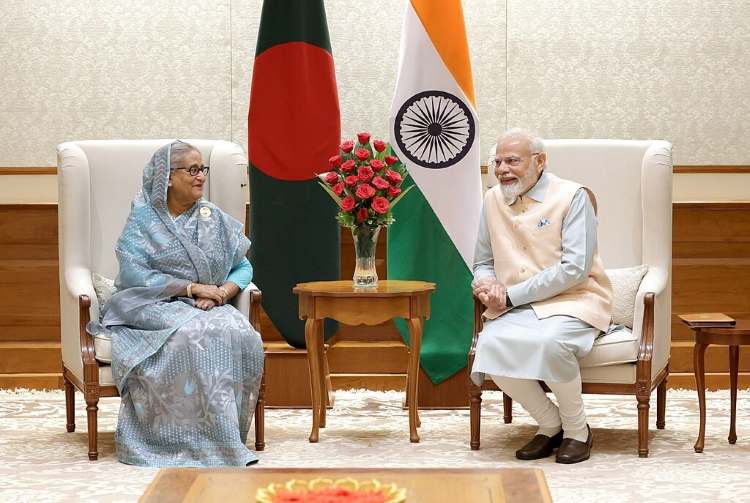
Request for Sheikh Hasina’s extradition: When Bangladesh’s International Crimes Tribunal read out the death sentence verdict against former Prime Minister Sheikh Hasina on November 17 for “crimes committed against humanity”, the Indian External Affairs Ministry’s reaction was cryptic. Taking note of the verdict against its erstwhile ally, New Delhi promised to “engage constructively with all stakeholders”.
Three weeks later, Indian External Affairs Minister S Jaishankar was even more enigmatic on Hasina’s fate, in the face of an extradition request from Dhaka, leaving it entirely on her to decide on returning to her country. This was in the backdrop of the Muhammad Yunus-led interim government’s efforts to officially seek Hasina’s extradition, based on a treaty signed some 12 years ago.
READ I Bangladesh’s new power play alarms India
Request for Sheikh Hasina’s extradition
Dhaka formally sought Hasina’s extradition on November 21. While India finds itself in a diplomatic spot of bother, especially when the extradition request followed a hurried judicial process in the ICT which imposed the death sentence against Hasina for alleged crimes committed during the July-August 2024 students protest, its legal implications have put the government in a legal, ethical and geopolitical conundrum.
The Indian government has acknowledged receiving the extradition request which was under examination. The Dhaka interim regime insists that it aligns with the 2013 agreement between the two countries, arguing that the treaty obligates India to return any person formally convicted of serious crimes, provided the request meets procedural standards.
India, however, has responded with caution and has not yet indicated whether it will accept, reject or seek further clarifications. Moreover, if any procedural issues exist, India could legally justify delaying or declining extradition.
Among the first steps before a country – in this case, Bangladesh – seeking extradition of a person from the country of refuge is to categorise an alleged offender as a “fugitive criminal”. The offences must be covered by the bilateral extradition treaty or convention to which both India and the requesting state are parties to.
READ I Political crisis in Bangladesh threatens regional stability
Documents for extradition request
An extradition request, backed by all relevant documents, including evidence and judicial papers, must be made to the Ministry of External Affairs or the central authority, where the Consular, Passport and Visa Division is the nodal point for receiving such requests. Under Chapter II of the 1962 Extradition Act, the process is “rigorous” and requires “prima facie” establishment of a case in which the evidence must be “sufficient to commit the case for trial had the offence been committed in India”.
However, rules and regulations under Chapter III of the Act provides for a “more swift” procedure. Under these rules, the need for establishing a prima facie case against an accused person is “dispensed with”. The documents, including an arrest warrant, shared by the requesting country, must satisfy an extradition magistrate who will need to establish that it has been endorsed by the host government. Besides, the magistrate must be sufficiently satisfied that the offences allegedly committed by the accused person constitute extradition offences.
The guidelines enshrined in the 1962 Act provide for the “provisional arrest” of the accused even when no formal extradition request has been made. However, provisional arrest requests – which has, so far, not been made against Hasina – must be “transmitted through diplomatic channels” to the MEA’s CPV Division. The services of the International Criminal Police Organisation (INTERPOL) can also be taken to transmit arrest requests.
The Act gives the requesting state concerned “limited time” – between 45 and 60 days – to submit a formal extradition request. Even if a court of law in the host country releases the fugitive criminal, this would “not prejudice” the “subsequent rearrest and extradition” of the accused person even if the extradition request and all relevant supporting documents are received at a later date.
A request for the surrender of a fugitive criminal may be made through diplomatic channels such as a diplomat based in Delhi or the requesting government or through the Indian mission in the foreign capital.
READ I Trump’s South Asia strategy leaves India isolated
Examining the case
Once the CPV Division receives an extradition request, it is subjected to an “examination”. If this is deemed “fit”, an inquiry magistrate may be appointed to inquire into the case. When a fugitive’s identity, supporting evidence, the Act’s provisions and the inquiry magistrate’s report on the surrender of the accused person are examined, the extradition magistrate “may commit” the person to prison and await the central government’s orders.
At this juncture, the extradition magistrate forwards the report, along with any “written statement” of the fugitive criminal, for the “consideration” of the central government.
If the extradition magistrate finds – after completing the inquiry – that a prima facie case is not established on the lines of the foreign state’s request, the fugitive criminal may be discharged.
The central government’s position becomes critical in such a situation. Once the central government examines the inquiry report and the fugitive criminal’s statement, it may “issue a warrant for the custody and removal” of the accused person to the requesting state “at a place and to a person” specified in the warrant.
On the other hand, the host state may refuse extradition if it concludes that it is being sought for “an offence of a political character”, if the offence is of a military nature, if the person whose extradition is being sought is “immune from prosecution or punishment” in the requesting state, if the person has been tried and acquitted, pardoned or underwent punishment earlier and if the requested state concludes that a person’s extradition is being sought for punishing him or her on account of his or her “race, sex, religion, nationality or political opinions”.
However, a fugitive criminal may be extradited if he or she “voluntarily deposes” before the inquiry magistrate and expresses willingness to face the charges or undergo sentence in the requesting state. But in this case, the inquiry magistrate must be satisfied that “dual criminality exists” before recommending to the central government, favouring extradition.
There is a final step in the extradition process: in the event the central government, after receiving the inquiry magistrate’s recommendation, decides to surrender the fugitive criminal to the requesting state, the modalities are worked out by the MEA and the foreign mission concerned. A requesting state escort officer then takes charge of the fugitive criminal and transports him or her back.
The inquiry magistrate’s recommendation is “appealable” in a high court or the Supreme Court of the host state. Besides, the non-removal of the fugitive criminal within two months after being committed to a prison by the inquiry magistrate makes him or her eligible to apply for a discharge “unless sufficient cause is shown to the contrary”.
More than the technical concerns, the most significant obstacle to extradition may be the death sentence. Under both Indian and international human rights norms, extraditing individuals who face capital punishment is discouraged unless guarantees against execution are stated.
In the past, India has refused extradition requests from several countries under similar circumstances, citing humanitarian grounds. In the Hasina case, allegations of political persecution have heightened these concerns.
Several factors will determine how the extradition request is examined. If India requests additional documentation or assurances, the process could get further delayed. At the same time, international human rights concerns assume significance, especially if global organisations call for protection or an independent review.
Ultimately, the extradition request represents a multifaceted intersection of law, justice, diplomacy and regional politics. For Bangladesh, it is a test of the interim government’s ability to enforce accountability against its former prime minister. For India, it is a moment of balancing legal obligations, humanitarian principles, international pressures and strategic interests. The decision India ultimately makes may alter political alignments, redefine legal precedents and influence South Asia’s geopolitical landscape.
Abhinav Mehrotra is Associate Professor, Jindal Global Law School, O.P. Jindal Global University, Sonipat, Haryana. Amit Upadhyay is Associate Professor, Jindal Global Law School, O.P. Jindal Global University, Sonipat, Haryana. Originally published under Creative Commons by 360info
