


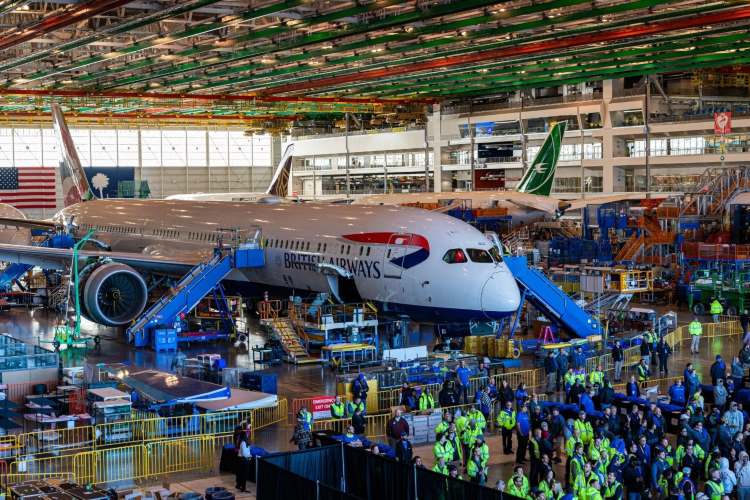
Donald Trump’s protectionist measures can raise barriers. They cannot, by themselves, rebuild industrial capability. That is the central problem in the current American debate. Tariffs are being used as a proxy for industrial policy. They may alter sourcing decisions at the margin and offer windfall gains for some firms. But a US manufacturing boom requires something tariffs cannot create: supplier ecosystems, predictable policy, skilled labour, engineering depth, factory automation, and competitive input costs.
Recent data already point to this gap. US manufacturing output did rise in January 2026, but capacity utilisation was below its long-run average, and the sector is operating far from a full-cycle surge. The manufacturing output rose 0.6% in January, while capacity utilisation stood at 75.6%, way below its historical norm.
That is not what a tariff-led renaissance looks like.
READ I Trump tariffs overturned: What it means for the world economy
Tariffs and US manufacturing output
Protectionist policy is often sold politically as a jobs strategy, but modern manufacturing does not follow this logic.
Even when output rises, employment gains can be weak because production is capital-intensive and automated. BLS payroll data for January 2026 show US manufacturing added just 5,000 jobs month-on-month, to 12.59 million, after a volatile 2025. Reuters also reported factory employment had declined materially over the previous year even as tariff policy intensified.
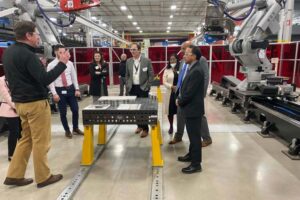

This is not an anomaly. It is a structural feature of advanced manufacturing. The sectors likely to expand in the US under industrial policy and strategic competition — semiconductors, advanced electronics, precision equipment, defence-linked manufacturing, clean-tech components — are not mass employers in the way textiles, basic assembly, or low-value consumer goods once were.
So the political promise of “more tariffs = more factory jobs” collides with the economics of automation.
READ I De-dollarisation 2026: Tariff war pushes countries to diversify
Manufacturing competitiveness depends on systems
The supplied material is strongest where it highlights a point many Western policy debates still understate: manufacturing competition today is about production systems.
China’s advantage is no longer reducible to low wages. It is about scale, supplier density, rapid iteration, logistics, and automation. The International Federation of Robotics says China accounted for 54% of global industrial robot installations in 2024, with 295,000 units installed in a single year and an operational stock above 2 million. This matters more than rhetoric about tariffs.
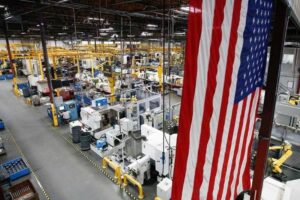
When firms choose production locations, they do not compare tariffs alone. They compare defect rates, tooling turnaround, engineering support, vendor reliability, shipping predictability, working capital cycles, and the ability to scale from pilot to volume. Report 2, despite its uneven quality, is useful on this point: companies optimise across cost, speed, logistics, quality assurance, and execution risk, not just headline labour rates.
A tariff can raise the cost of imports. It cannot instantly create a Shenzhen-like supplier network in Ohio.
READ I Trump’s ‘golden age’ descends into global chaos
Protectionism can raise costs for domestic firms
A second problem is internal contradiction. US manufacturing is import-dependent.
American factories import machine tools, electronics, metals, chemicals, and intermediate components. Tariffs on broad categories therefore act as taxes on downstream production unless exemptions are carefully designed and stable. Recent reporting continues to show this pattern: Reuters noted manufacturing has been “hamstrung” by sweeping tariffs, even as some segments tied to AI-related investment remain strong.
The inflation channel matters too. The Budget Lab at Yale finds meaningful pass-through from tariffs to consumer goods prices in 2025, with imported PCE core goods and durables prices rising above prior-year comparisons. PIIE’s trade-war update similarly estimates lower US growth and higher inflation relative to baseline under tariff escalation.
That combination is politically awkward and economically counterproductive. If tariffs lift input costs and consumer prices, the Federal Reserve has less room to support a broad industrial recovery through easier monetary conditions.
Policy volatility is now a manufacturing tax
Manufacturing investment requires long horizons. Trump-era tariff policy has often delivered short horizons.
The legal and policy uncertainty around tariffs has become part of the cost structure. After the US Supreme Court struck down Trump’s sweeping tariffs under emergency authorities, the administration moved quickly to impose a temporary across-the-board tariff under Section 122, first at 10% and then 15%, while excluding some categories and preserving exemptions such as USMCA-compliant goods from Canada and Mexico.
This may preserve negotiating leverage. It does not create planning certainty.
Firms deciding on plants, tooling, vendor contracts and component sourcing need to know the tariff regime over 5-10 years, not 150 days. Frequent changes in rates, product coverage and exemptions encourage hedging, inventory management and geographic diversification. They do not encourage irreversible domestic capital commitments at scale.
China has adapted faster than Washington assumed
The other strategic misread is that tariffs would force a rapid contraction in Chinese manufacturing power.
Recent trade data suggest otherwise. Reuters reported China posted a record $1.189 trillion trade surplus in 2025, driven by export diversification to non-US markets. Another Reuters report showed Chinese exports to the US fell sharply in November 2025, but exports to the EU, Australia and Southeast Asia rose strongly, offsetting part of the damage.
This is exactly why tariff-led containment is difficult. Large manufacturing systems reroute. They cut prices. They shift final assembly. They expand in third markets. They move up value chains while defending volume in lower-value goods.
Meanwhile, US buyers continue to depend on imported capital goods and electronics. Reuters reported record US goods imports in 2025 and a record goods trade deficit, even as tariffs were meant to narrow that gap.
Tariffs can change bilateral balances. They do not automatically improve national manufacturing competitiveness.
US manufacturing and capability formation
The more serious constraint on any American manufacturing revival is capability formation.
Deloitte’s December 2025 analysis puts the issue plainly: tariffs are not a silver bullet if the US lacks the skilled workforce needed to scale modern production. It also notes manufacturing’s shrinking share of the economy and the shift toward higher-value, capital-intensive sectors with limited employment multipliers. Deloitte’s manufacturing outlook also points to persistent workforce challenges, rising labour costs, and the risk of unfilled jobs in the coming decade.
This does not mean a US manufacturing strategy is doomed. It means the instrument mix is wrong.
Washington has, in fact, seen large investment commitments in factory construction over the past few years; manufacturing construction spending remains elevated by historical standards even after easing from peak levels. FRED data based on US Census figures still show manufacturing construction spending above $214 billion (SAAR) in October 2025. But construction spending is the beginning of industrial expansion, not proof of operating competitiveness.
Factories can be built faster than ecosystems.
A tariff wall cannot substitute for an industrial base
The strongest case for selective protection is narrow and practical: buy time for domestic capacity in strategically critical sectors. That case can be argued for semiconductors, defence inputs, grid equipment, and some clean-energy components.
But that is different from promising a generalised manufacturing boom.
A durable revival would require stable trade rules, targeted incentives tied to performance, power and logistics upgrades, vocational training, immigration policies that support technical labour supply, and coordination with allies on minerals, components and standards. Tariffs may appear at the edge of that architecture. They cannot be the architecture.
If the US continues to treat manufacturing as a trade-war slogan rather than a systems-engineering challenge, protectionism will mainly do three things: raise costs, reward lobbying, and postpone harder reforms. That may produce headlines. It will not produce a manufacturing renaissance.